

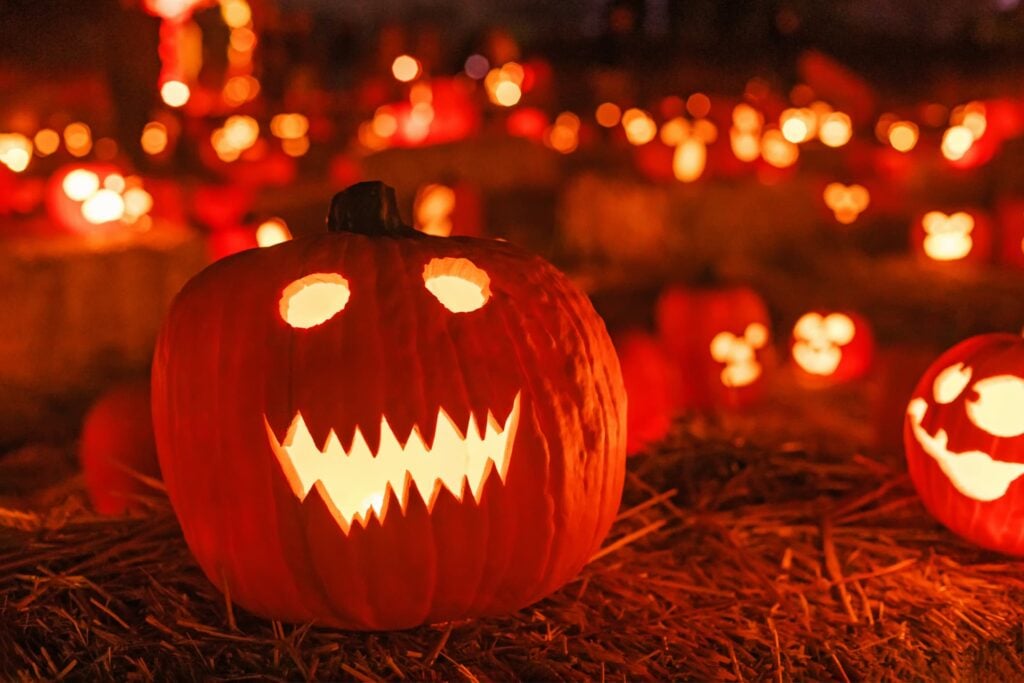
Halloween
Saturday 31 October 2026 · every year on 31 October
Halloween is a folk festival that grew out of the Celtic festival of Samhain and the Christian feast of All Saints, which is why the Church of England still describes the name as meaning “the eve of all hallows’ day”.
Also on 31 October: Museums At Night · World Savings Day · National Unity Day
What Halloween is
This year: Halloween 2026 is on Saturday 31 October. See the Halloween 2026 page for this year’s date, theme and what’s on.
Halloween is on 31 October every year. The date never moves, so the only thing that changes is the day of the week: in 2026 it falls on a Saturday, in 2027 on a Sunday and in 2028 on a Tuesday. It is not a bank holiday anywhere in the UK, and there is no organising body behind it. Halloween is a folk festival that grew out of the Celtic festival of Samhain and the Christian feast of All Saints, which is why the Church of England still describes the name as meaning “the eve of all hallows’ day”. For the history, the most reliable UK sources are English Heritage and the Church of England, both of which are drawn on below.
| Year | Date |
|---|---|
| 2026 | Saturday 31 October 2026 |
| 2027 | Sunday 31 October 2027 |
| 2028 | Tuesday 31 October 2028 |
Halloween is the night of 31 October, the evening before All Saints’ Day on 1 November and All Souls’ Day on 2 November. In Britain it is marked with pumpkin carving, fancy dress, trick-or-treating and ghost walks at castles and stately homes. For most people it is a light-hearted evening for children; for churches it opens three days of remembering the dead; for pagans it is Samhain, the turn of the year.
Because nobody runs Halloween, there is no annual theme, official hashtag or campaign. The traditions are the point, and the history below gives a school assembly or workplace event plenty to work with.
Why Halloween is on 31 October
The date comes from the church calendar. All Saints’ Day, once known as All Hallows, was fixed on 1 November, so the evening before became All Hallows’ Eve, shortened over the centuries to Halloween. English Heritage notes that Samhain was held around the same date, marking the move from autumn to winter, and that All Saints’ Day absorbed many of its customs. That fixed date is why Halloween, unlike Easter, is on the same day of the month every year.
Plan around Halloween and every key date in October
The Awareness Days Toolkit puts every awareness day for 2026 and 2027 in a spreadsheet, printable PDF calendars and an iCal feed that keeps itself up to date.
A short history
Modern Halloween is generally agreed to have grown out of Samhain, when people believed the boundary between the living and the dead blurred and the souls of the dead revisited their homes. As Christianity spread, bonfires, parades and dressing up blended into the church’s All Saints’ and All Souls’ festivities.
Several things people think of as American are in fact British or Irish. English Heritage’s historian Dr Michael Carter traces trick-or-treating to medieval “souling”, when poorer neighbours went door to door around All Souls’ Day and were given small oat “soul cakes” in return for praying for the household’s dead. Soul cakes are first recorded around 1400 and the custom survived in parts of Cheshire, Shropshire, Staffordshire and Sheffield into living memory. Dressing up comes from Scottish “guising”, where a costume let you make mischief without being recognised. The jack-o’-lantern began as a carved turnip, beetroot or potato set by the door to frighten off wandering spirits; nineteenth-century emigrants to the United States found pumpkins far easier to carve. Trick-or-treating as we now know it is, in English Heritage’s words, essentially a recent import from the United States, but one with ancient roots in these islands.
Halloween in the UK
Halloween here is quieter than in the United States, but it has grown steadily since the 1980s. A few things are distinctly British:
- Half-term. In most of England and Wales the October half-term week runs up to Halloween. For 2026, most councils, including Southwark, list it as Monday 26 to Friday 30 October, so Halloween falls on the Saturday at the end of the break. Dates vary by local authority, so check your council’s term dates on gov.uk. The overlap is why National Trust and English Heritage properties run pumpkin trails across the whole week.
- Bonfire Night. Guy Fawkes Night is five days later on 5 November, a Thursday in 2026, and most organised displays are held on the nearest weekend, so the two can feel like one fortnight of fireworks and toffee apples. They are not historically connected: Bonfire Night marks the failed Gunpowder Plot of 1605.
- Shops and pubs. Supermarkets stock costumes, pumpkins and sweets from late September and clear them for Christmas on 1 November. Pubs run fancy-dress nights on the nearest Friday and Saturday, which in 2026 means Halloween itself.
- Churches. Many Church of England parishes hold “light parties” for children around 31 October as a positive alternative.
- Pumpkin waste. The charity Hubbub, which started Pumpkin Rescue in Oxford in 2014 and now runs it as Eat Your Pumpkin, says millions of pumpkins are bought in the UK each year but never eaten. Carving pumpkins are edible: use the flesh for soup, roast the seeds, and compost the shell.
Trick-or-treating in the UK: when, where and how
There is no law about trick-or-treating, but councils and police forces publish the same conventions every October.
- Timing. Most families go out once it is dark, roughly between 5pm and 8pm. Councils such as Havering ask that nobody calls late in the evening, and that older children have a planned route and a set time to be home.
- Which houses. A lit pumpkin or decorations outside is the usual signal that a house is taking part. Only knock at houses you know or that are clearly decorated, and never go inside.
- “No trick or treat” signs. Neighbourhood Watch, police forces and councils offer printable posters for people who do not want callers, often older residents or families with sleeping babies. If a sign is in the window, walk on.
- Behaviour. Say thank you and accept whatever is offered; never demand money. Throwing eggs or flour at houses or people can be criminal damage or assault.
- Safety. Younger children should be with an adult. Go in a group, stick to well-lit streets, carry a torch, choose visible, flame-resistant costumes, and use LED tea lights rather than candles in doorstep pumpkins.
If you are happy to receive callers, a lit pumpkin by the door and a bowl of wrapped sweets is all you need.
How to take part
At home
- Carve a pumpkin, or go traditional with a turnip as people did before pumpkins arrived. Keep the flesh for soup.
- Bake soul cakes. English Heritage’s recipe uses flour, mixed spice, butter, sugar, currants and oats, scored with a cross on top.
- Try apple bobbing, a game from the end of the harvest season, and look out for Apple Day on 21 October.
At school
- Use the souling and guising history for a lesson on how customs travel and change, and on the difference between All Hallows’ Eve, All Saints’ Day and All Souls’ Day.
- Run a pumpkin-carving or decorated-turnip competition in the last week before half-term, and send home the trick-or-treat advice above on the final day.
At work
- A fancy-dress day on the nearest working day (Friday 30 October in 2026) works well as a charity fundraiser with a small entry fee.
- Keep it optional; a themed bake sale includes everyone.
Frequently asked questions
When is Halloween?
Halloween is on 31 October every year. The date is fixed, so it does not move the way Easter does.
What day is Halloween 2026?
Halloween 2026 is on Saturday 31 October 2026. In 2027 it is on a Sunday and in 2028 on a Tuesday.
Is Halloween a bank holiday in the UK?
No. Halloween is not a public holiday anywhere in the UK, and shops, schools and offices open as normal. In most of England and Wales it falls in or just after the October half-term week.
Why is Halloween on 31 October?
Because it is the eve of All Saints’ Day, or All Hallows, on 1 November. “Hallowe’en” is a contraction of All Hallows’ Eve. The Celtic festival of Samhain fell at the same point in the year and many of its customs were absorbed into the church feast.
What time does trick-or-treating start and finish in the UK?
There is no official time, but the convention is after dark and before about 8pm, with younger children out earliest. Councils and police ask callers not to knock late in the evening and to skip any house with a “no trick or treat” sign.
More awareness days in October
See all → 1–31 OctMonth1 Oct to 31 OctMonthCommunityUKBlack History Month
 1–31 OctMonth1 Oct to 31 OctMonthCancerUK, US, Australia and worldwideBreast Cancer Awareness Month 2026
 1 Oct1 OctThursdayFood & NutritionUK, US, Australia and worldwideInternational Coffee Day 2026
 1–7 OctWeek1 Oct to 7 OctWeekFood & NutritionInternationalNational Vegetarian Week 2026
 1–31 OctMonth1 Oct to 31 OctMonthHealth & WellbeingUKStoptober 2026
 2 Oct2 OctFridayCommunityInternationalWorld Smile Day 2026
 5 Oct5 OctMondayOctober Awareness DaysUK, US, Australia and worldwideWorld Teachers Day 2026
 10 Oct10 OctSaturdayHealth & WellbeingInternationalWorld Mental Health Day 2026