Green Careers Week 2026
Monday 2 November to Saturday 7 November 2026
Green Careers Week runs from 2 to 7 November 2026. Explore practical school, college and employer activities with links to the official resources.
Add this date to my calendarA full year of awareness dates, ready to edit, print or sync.
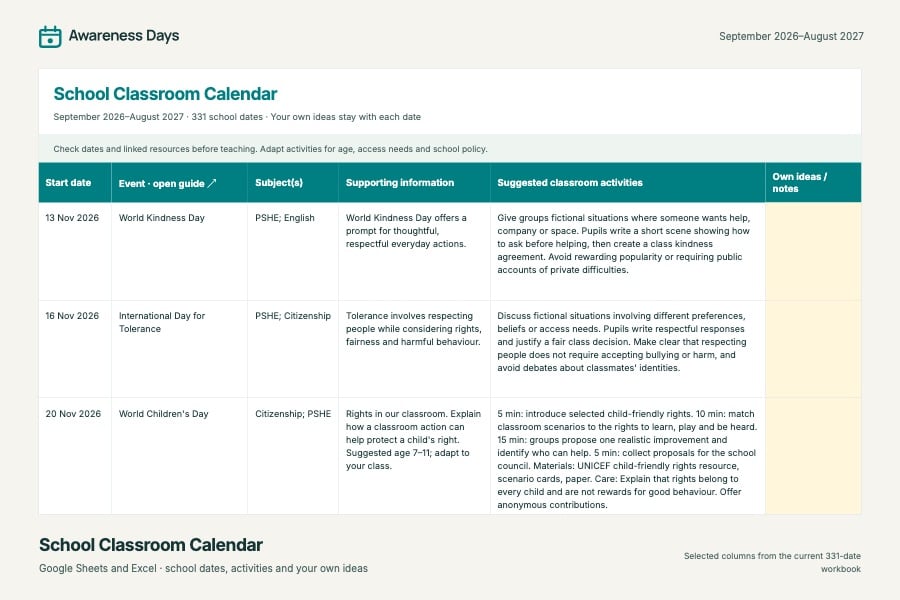
Get the full 2027 school calendar£49.99 a year. Renews annually.
On this page
Dates and event details
Monday 2 November to Saturday 7 November 2026. Held dates set by the organiser each year.
| Date status | Date source-confirmed for 2026 |
|---|---|
| Date-check source | Green Careers Week, founder Nick Newman / National Careers Week resources network |
| Where | UK |
About Green Careers Week
Green Careers Week runs from 2 to 7 November 2026. This UK careers campaign helps people explore jobs, career pathways and skills connected with environmental change. The organiser provides free partner resources that can be used in schools, colleges, careers conversations and workplace outreach.
When is Green Careers Week?
The official Green Careers Week website gives Monday 2 to Saturday 7 November 2026. Use that full range when adding the campaign to your calendar. Schools can choose activities within their teaching week, while families and community groups can plan around the wider campaign period.
Dates for a 2027 edition have not been verified. Check the organiser’s website for future announcements before rolling your plans forward.
Date and official information
The date range and resource links were checked against the organiser’s website on 23 October 2026. This listing uses its confirmed 2–7 November dates. Activity suggestions above are editorial planning ideas; no unannounced future dates or campaign themes are assumed.
Ideas for schools and colleges
The following are suggested activities to adapt to your setting, using current official resources where appropriate:
- Build a careers question board. Ask learners what they want to know about jobs connected with the environment. Group their questions into work tasks, entry routes, skills and local opportunities.
- Investigate a familiar place. Choose a school, library or sports centre. Explore who might help it use energy, manage materials or care for outdoor spaces, then research the roles involved.
- Compare two pathways. Ask pupils to use reliable careers information to investigate routes into a role. Record entry requirements as questions to verify with the relevant training provider.
- Plan a focused visitor session. Give a speaker the learners’ questions in advance and leave time for a discussion about their everyday work.
Finish with something each learner can do next, such as reading a role profile, discussing a subject choice with a careers adviser or preparing questions for an open event. Keep opportunity information specific to the learner’s location and stage of education.
What can you explore during the week?
The campaign introduces green careers, roles and pathways, alongside opportunities to develop green skills. Its website brings together resources from partners including STEM Learning, BBC Bitesize, Morrisby and the UK Atomic Energy Authority. It also offers an overview designed for assemblies, tutor groups and lessons.
A useful careers activity starts with questions that matter to learners: What would I do in this job? Which skills would I use? What could I study or try next? Ask visitors and resource providers to explain their examples in clear language, including the practical work behind a job title.
How employers can take part
Employers can offer a short career story, a question-and-answer session or an explanation of one real task. Show the process as well as the finished result: who contributes, what decisions are involved and which skills the team uses.
When describing a role’s environmental contribution, give a concrete example that your organisation can explain. Be clear about the difference between an introductory school activity and an advertised vacancy, placement or apprenticeship. Link to current recruitment information when discussing opportunities.
A simple planning checklist
Choose your audience and one learning goal. Review the organiser’s resources, agree a session with the relevant teacher or careers lead, and check that materials are suitable for the group. Share an outline in advance and allow learners to submit questions in different ways.
Afterwards, gather the links in one place and ask learners which role they would like to investigate further. This gives a careers conversation somewhere useful to go after the campaign finishes.
Related dates include National Careers Week, British Science Week and World Environment Day.