

Purple Tuesday 2026: accessible customer experiences
2026 date verification pending
2026 date verification pending. The stored calendar entry (Tuesday 3 November 2026) is provisional. The campaign website has not confirmed a 2026 event. Check for an organiser update before making plans. Purple Tuesday campaign website.
Purple Tuesday: accessible customer experiences: 2026 date verification pending. Use the date disclosure and source below before planning around the provisional entry.
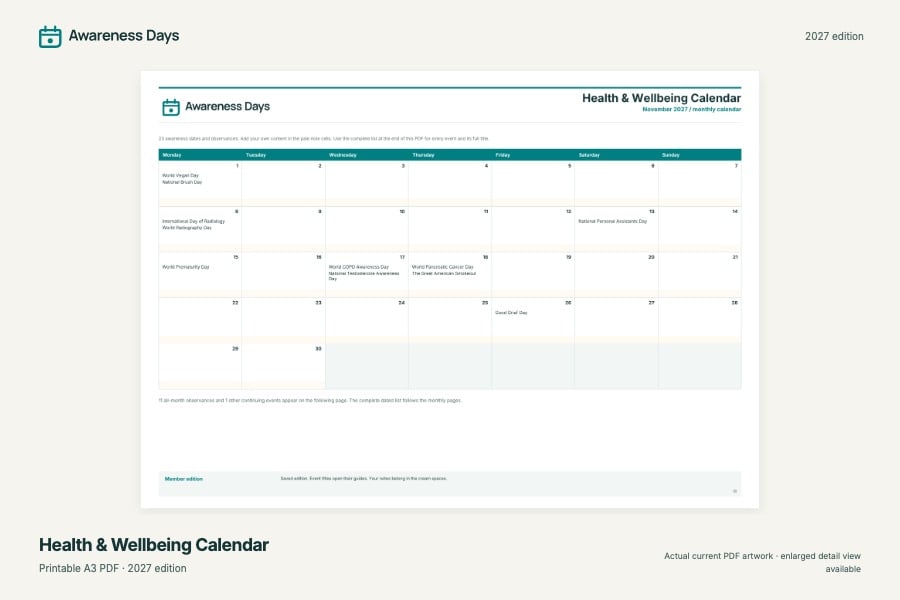
A full year of awareness dates, ready to edit, print or sync.
Get the full 2027 health calendar£39 a year. Renews annually.
On this page
Dates and event details
2026 date verification pending. The stored calendar entry (Tuesday 3 November 2026) is provisional. The campaign website has not confirmed a 2026 event. Check for an organiser update before making plans. Purple Tuesday campaign website.
| Date status | 2026 date verification pending |
|---|---|
| Provisional entry | Tuesday 3 November 2026 |
| Date-check source | Purple Tuesday campaign website |
| Where | United Kingdom / international participation |
What is Purple Tuesday?
Purple Tuesday has focused on accessible, inclusive customer experiences, both in person and online. The Edinburgh Tourism Action Group’s 2026 listing describes participation through a new accessibility commitment, implementation and shared celebration.
That partner listing provides context, but it should not be taken as proof of a current organiser-run programme. This guide offers independent activity ideas rather than instructions for an official 2026 registration.
A 2026 Purple Tuesday programme has not been verified on the campaign website. Tourism partners list Tuesday 3 November 2026, but the Purple Tuesday homepage currently displays a thank-you message reflecting on eight years of support, without a current programme or registration route.
Check for an organiser update before treating 3 November as a confirmed event date. In the meantime, businesses and community organisations can continue the practical work associated with the campaign: improving customer experiences for disabled people and their families.
Start with a real customer journey
Choose one task someone needs to complete: finding access information, booking a visit, buying a ticket or asking for help. Walk through that task with disabled customers or an appropriate access adviser, and ask what creates avoidable difficulty.
Provide accessible ways to contribute and budget for people’s time where you are asking for organised feedback. Do not expect one person to represent every disability or to provide a complete audit informally.
Turn feedback into one clear commitment
- Describe the barrier: for example, customers cannot find reliable entrance information before travelling.
- Choose a specific improvement: publish clear entrance details and photographs, with a direct contact route for questions.
- Name an owner and deadline: give someone responsibility for checking the information and keeping it current.
- Test the result: invite feedback on whether the change makes the task easier, then act on what you learn.
Other starting points might be clearer booking instructions, a way to request an alternative format or better staff information about available assistance. Choose an improvement relevant to your service rather than announcing a broad promise that cannot be checked.
Communicate access information honestly
Explain what a customer will encounter, what help is available and how to ask a question. A general “fully accessible” label often tells people less than specific details about entrances, seating, toilets, sensory conditions or communication options.
For a digital service, test the task as well as the page’s appearance. Include people who use different input methods and assistive technologies, and use qualified accessibility support where needed. A single improvement does not establish that every part of a service is accessible.