

Talk Money Week 2026
Monday 2 November to Friday 6 November 2026
Talk Money Week is a UK campaign encouraging open conversations about money. Employers, educators and community groups can help people ask questions, find reliable guidance and take a manageable next step.
Add this date to my calendarA full year of awareness dates, ready to edit, print or sync.
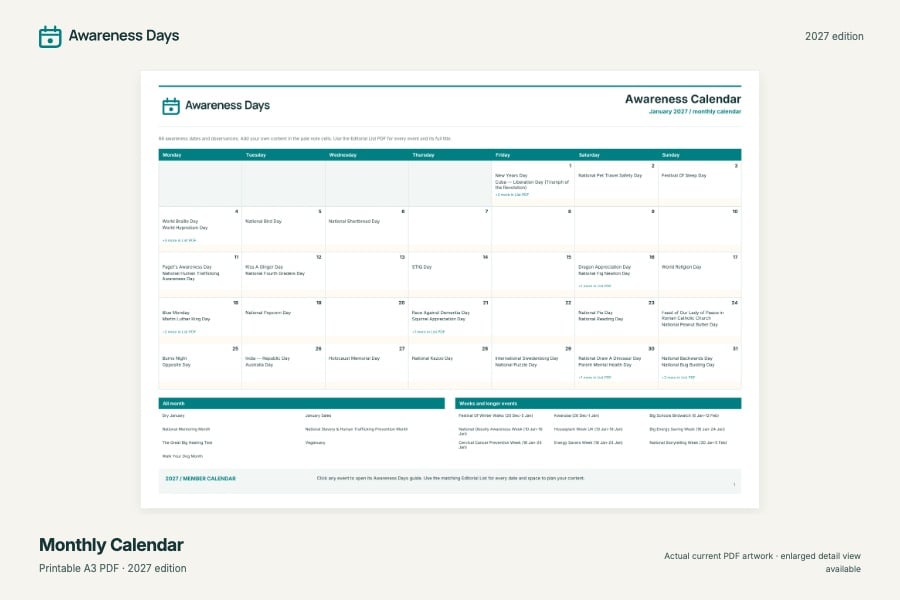
Get the full 2027 awareness days calendar£39 a year. Renews annually.
On this page
Dates and event details
Talk Money Week 2026 runs from Monday 2 to Friday 6 November.
| Where | UK |
|---|
What is Talk Money Week?
Talk Money Week is the Money and Pensions Service’s annual UK campaign encouraging more open conversations about money. It gives employers, educators, community organisations and families a shared opportunity to make those conversations easier to start and to connect people with reliable help.
A useful activity can be small: explaining a workplace benefit, discussing a household bill or showing someone where to find free guidance. People should not need to reveal their income, debts or account details to take part.
What is the Talk Money Week 2026 theme?
The current theme is “It All Counts”, focusing on realistic, manageable actions. A campaign does not need to solve every financial issue in one week. It can help someone identify a question, understand where to get guidance and choose a practical next step.
When is Talk Money Week 2026?
The confirmed dates are 2–6 November 2026. The Money and Pensions Service campaign page provides the current participation pack, event map and information for organisations.
Use these announced dates for the 2026 calendar. Check the organiser’s announcement for future years rather than assuming that a particular numbered week in November is a permanent rule.
Talk Money Week ideas for workplaces
The following are suggested activities for an employer or staff group. Choose a subject your organisation can explain accurately and keep personal questions private.
- Explain an existing benefit. Show where staff can find eligibility information, how to apply and whom to contact about a specific question.
- Check the information people receive. Ask whether payslip guidance and benefits pages use language staff can understand. Fix one confusing explanation.
- Offer anonymous questions. Collect general topics before a session, then explain where individual cases need confidential support.
- Include different working patterns. Share the same information with shift workers, part-time staff and remote colleagues.
- Publish one useful follow-up. Keep a verified resource page available after the week, with a named person responsible for maintaining it.
A lunch-and-learn session should make clear whether the speaker provides general information or regulated advice. Avoid presenting a product promotion as independent financial guidance.
Ideas for schools and community groups
Use an invented example rather than asking children or participants about their family finances. A group could compare two fictional shopping baskets, identify the information missing from an offer or discuss how to ask a trusted adult for help with a money question.
For a community session, choose one task and allow enough time for questions. For example, help people locate a reliable service directory without collecting their personal financial details. Explain the limits of the session and arrange an appropriate referral for individual concerns.
How to start a conversation about money
MoneyHelper’s conversation guide suggests considering when and where to talk, giving the other person some notice and making space to listen. It also addresses difficult reactions and situations where talking may not feel safe.
For a routine household discussion, try a specific invitation: “Could we set aside some time to look at this bill together?” Agree the subject before introducing paperwork or asking for a decision. End by checking what each person has understood and whether another conversation is needed.
If money is being used to control someone, a joint budgeting conversation may not be the right response. Use specialist guidance rather than assuming that every financial disagreement can be resolved by talking together.
Making the week useful afterwards
Decide in advance what you will review. Count questions answered, information made clearer or people directed to a relevant resource. Do not ask staff to disclose balances or private financial outcomes as a measure of campaign success.
Where to find official resources
Start with the MaPS campaign page for the current participation pack and event information. Its resources are intended to help organisations plan their own contribution. Check the pack’s year before printing or sharing it.
For an individual money question, MoneyHelper provides free money and pensions guidance and routes to further support. An awareness activity should help people find appropriate guidance, rather than tell a whole audience which financial product or debt solution to choose.
Reviewed 23 October 2026. Confirmed MaPS dates, theme and resources; replaced generic financial advice with practical conversation and activity planning.
Frequently asked questions
When is Talk Money Week 2026?
It takes place from Monday 2 to Friday 6 November 2026.
Who organises Talk Money Week?
The Money and Pensions Service runs the UK campaign.
What is the current theme?
The 2026 campaign page gives the theme as “It All Counts”, with a focus on manageable actions.
Do I have to discuss my own finances?
No. An activity can use general information or fictional examples. Personal money questions should have an appropriate private route.