

World Turkic Language Family Day 2026
Tuesday 15 December 2026
Dates can vary from year to year, so check the organiser’s website for the latest details.
World Turkic Language Family Day on 15 December celebrates linguistic heritage, learning and exchange across the Turkic language family.
Add this date to my calendarA full year of awareness dates, ready to edit, print or sync.
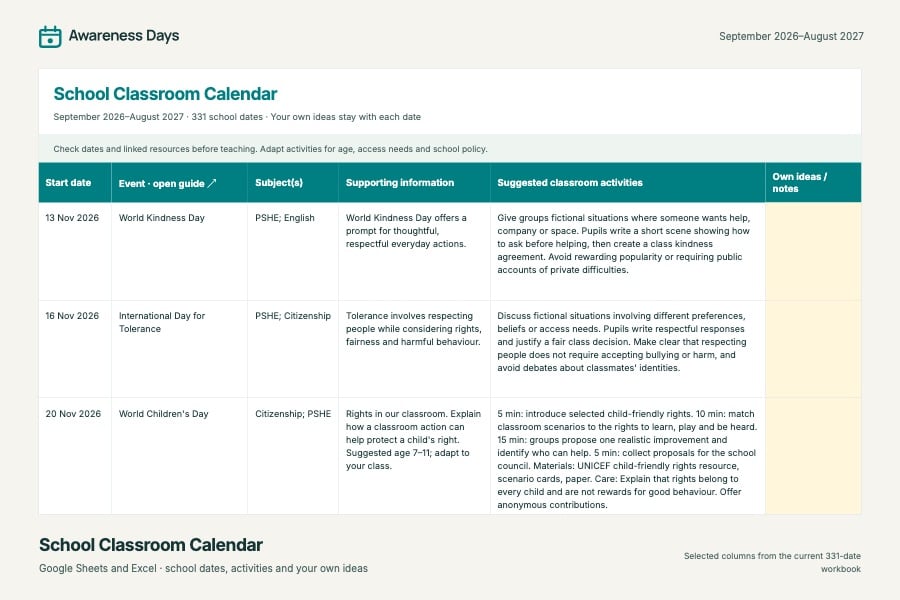
Get the full 2027 school calendar£49.99 a year. Renews annually.
On this page
Dates and event details
Tuesday 15 December 2026. Held every year on 15 December.
| Date status | Date calculated from a fixed annual pattern |
|---|---|
| Date-check source | Official observance organiser |
| Where | International |
About World Turkic Language Family Day
World Turkic Language Family Day is observed annually on 15 December, including Tuesday 15 December 2026. This UNESCO observance offers an opportunity to explore the languages, literature and cultural heritage associated with the Turkic language family, and to encourage learning and exchange.
Ideas for schools and libraries
- Create a carefully labelled language display. Use reliable reference works and identify each language separately. Check the spelling and meaning of any examples before displaying them.
- Compare translations. Read a short work in an authorised translation and discuss the translator’s role. Follow copyright permissions when reproducing a text.
- Investigate a writing system. Look at an official educational example and ask how letters, sounds and historical change are explained.
- Explore the Orkhon connection. Use a suitable historical source to examine how inscriptions can become evidence and what questions researchers bring to them.
Community and workplace activities
A community centre or library could organise a reading, conversation or exhibition with a relevant teacher, translator or cultural organisation. Agree how names and languages will be presented in publicity. Offer contributors an opportunity to check descriptions of their work and make arrangements for accessibility, payment and recording in advance.
Workplaces can use the day to recognise language skills that support communication with colleagues and customers. An optional language session might introduce a few accurately checked words or explore how professional translation works. Nobody should be expected to teach, translate or represent a community simply because of their family background.
A reading group could choose one author and a reputable translation, making clear which country, period and language are involved. A small programme that treats one work thoughtfully is often more informative than a broad display that combines unrelated cultural examples without explanation.
What does the day recognise?
UNESCO’s 43rd General Conference, held in Samarkand in 2025, proclaimed the day. The date recalls the announcement by linguist Vilhelm Thomsen on 15 December 1893 concerning the decipherment of the Orkhon inscriptions. That historical connection provides one route into learning about language, writing and the interpretation of evidence.
The term “Turkic” refers to a language family. It should not be used as though it means only the Turkish language or the culture of a single country. A good activity identifies the particular language, author, place or community being discussed and avoids suggesting that the family is culturally uniform.
Explore language through specific examples
Begin with a reliable introduction and choose a manageable question. How is a particular language written? What can a bilingual dictionary explain? How does a translator approach a poem or story? Naming the source and language helps participants appreciate differences as well as connections.
Language learning can also be an opportunity to discuss how knowledge is preserved and shared. Libraries, teachers, translators and community groups all have different expertise. A speaker should be able to define the scope of their contribution rather than being expected to explain every language or tradition associated with the family.
Plan a useful next step
Ask participants what they would like to learn next and point them towards a library collection, a language course or an appropriate cultural programme. Keep a note of the references used so that a misspelling or misunderstanding can be corrected. The aim is informed curiosity and exchange, with accurate credit for the people whose work is shared.
Related language learning dates include Arabic Language Day and the European Day of Languages.
Source check: 23 October 2026. The annual date was checked against the official UN catalogue entry; the proclamation and historical date were checked against the official Turkish foreign ministry announcement. No 2026 theme is assumed.