

International Day of Safe, Secure and Trustworthy Artificial Intelligence 2027
Tuesday 31 August 2027
Dates can vary from year to year, so check the organiser’s website for the latest details.
Safe, Secure and Trustworthy AI Day on 31 August provides a focus for learning and cooperation around the safe, secure and trustworthy development and use of artificial intelligence.
Add this date to my calendarA full year of awareness dates, ready to edit, print or sync.
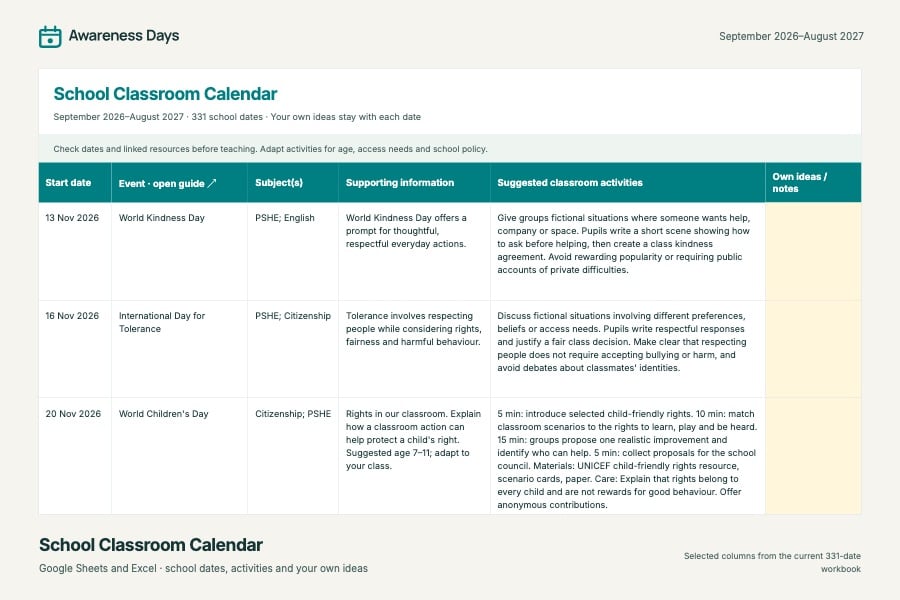
Get the full 2027 school calendar£49.99 a year. Renews annually.
On this page
Dates and event details
International Day of Safe, Secure and Trustworthy Artificial Intelligence 2026 was on Monday 31 August 2026. The next International Day of Safe, Secure and Trustworthy Artificial Intelligence is on Tuesday 31 August 2027.
| Date status | Date calculated from a fixed annual pattern |
|---|---|
| Date-check source | United Nations / relevant organiser |
| Where | International |
What is the day about?
The observance is an opportunity to ask practical questions about how AI systems are developed, used and assessed. A school, workplace or community group can choose one use case and consider the people affected, the evidence available and the responsibilities involved. Keep learning distinct from a product demonstration that is primarily intended to sell a service.
International Day of Safe, Secure and Trustworthy Artificial Intelligence takes place on 31 August 2027. This international observance provides a focus for learning and cooperation around the safe, secure and trustworthy development and use of artificial intelligence. It offers schools, organisations and communities a focused occasion for suitable learning and practical activity.
Date and official background
The annual date is 31 August. The 2027 occurrence follows that fixed annual rule. No unannounced 2027 theme or event programme is assumed. See the official source for background and resources.
The official General Assembly register records adoption of resolution A/RES/80/302 on 31 August 2026, following draft A/80/L.106. The UN’s central observance calendar places the day on 31 August. The 2027 listing follows that annual calendar date; it does not imply that a particular technology or supplier has UN approval.
Ideas for schools and workplaces
The following are original editorial planning suggestions to adapt to your audience, rather than an official programme.
- Examine a defined use case. Choose a task such as drafting a message or summarising a public text. Ask which errors matter, who checks the result and what the system should not be asked to decide.
- Compare a result with its sources. Use non-sensitive material and check claims against reliable originals. Record the difference between an answer that sounds plausible and one supported by evidence.
- Map responsibilities. Identify who chooses a tool, approves its use, reviews outputs and responds when something goes wrong. Keep the exercise connected to the organisation’s actual processes.
- Discuss participation and access. Ask whose needs are represented and which users may encounter barriers. Invite relevant expertise rather than assuming that one technical perspective covers every effect.
Planning and participation
For an educational session, use resources and tools appropriate to the setting’s established policies. Avoid putting personal, confidential or otherwise unsuitable information into a demonstration. A useful exercise can use fictional records or public documents and make clear which parts of the activity are illustrative.
When inviting a speaker or vendor, agree the purpose of the session and disclose relevant commercial interests. Ask what evidence supports a claim about performance or safety. A tool’s inclusion in a workshop should not be presented as certification, professional advice or an endorsement by the United Nations.
Official information
The date and factual background were checked against official organiser or UN-system information on 23 October 2026. Check new announcements before using edition-specific themes or programmes. Practical activities here are editorial suggestions.
Frequently asked questions
When is International Day of Safe, Secure and Trustworthy Artificial Intelligence 2027?
What is International Day of Safe, Secure and Trustworthy Artificial Intelligence 2027?
More awareness days in August
See all → 8 Aug8 AugSundayAnimals & WildlifeUK, US, Australia and worldwideInternational Cat Day 2027
 19 Aug19 AugThursdayCommunityInternationalWorld Humanitarian Day 2027
 19 Aug19 AugThursdayArts & Culture AwarenessInternationalWorld Photography Day 2027
 23 Aug – 6 SepWeek23 Aug to 6 SepWeekSeasonalInternationalBack to School 2027