International Week of Science and Peace 2026
Monday 9 November to Sunday 15 November 2026
The 2026 UN calendar lists 9–15 November for a week exploring science, cooperation and peace.
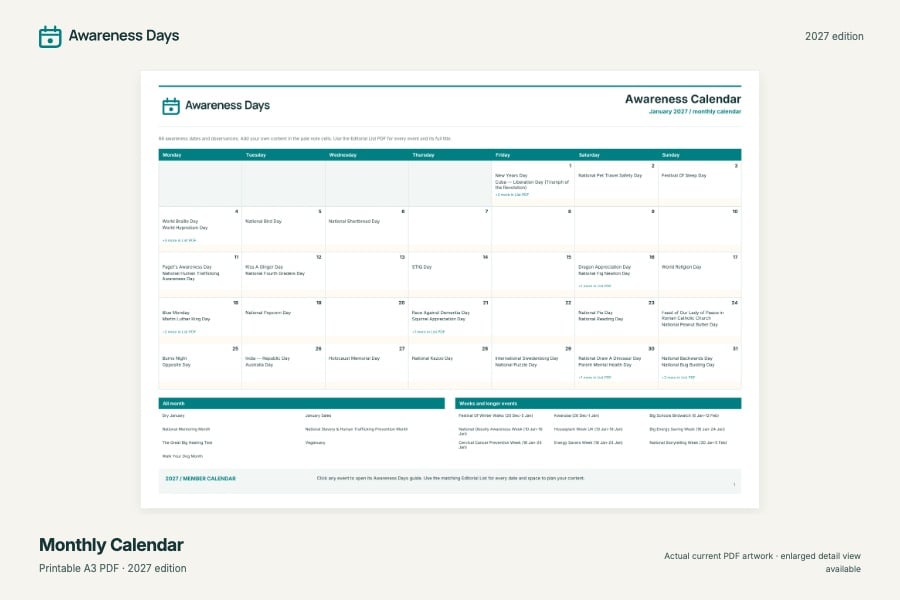
Add this date to my calendarA full year of awareness dates, ready to edit, print or sync.
Get the full 2027 awareness days calendar£49.99 a year. Renews annually.
On this page
Dates and event details
Monday 9 November to Sunday 15 November 2026. Held dates set by the organiser each year.
| Date status | Date source-confirmed for 2026 |
|---|---|
| Date-check source | Official observance organiser |
| Where | International |
What is the week about?
Scientific work often requires people to share observations, compare methods and test one another’s explanations. Those habits offer useful starting points for discussing cooperation. The week creates space to consider how research and technology serve society, and how scientific knowledge can contribute to environmental, social and economic development.
It is a different observance from World Science Day for Peace and Development on 10 November, although the dates sit together and activities can complement one another. A week-long programme gives a group room to develop a question over several sessions rather than relying on a single presentation.
International Week of Science and Peace brings attention to the contribution that science, technology and cooperation can make to peace. The UN’s event calendar lists 9–15 November 2026 for the current edition. Its explanatory page describes the annual rule as the week in which 11 November falls.
When is International Week of Science and Peace?
The 2026 calendar range is Monday 9 to Sunday 15 November. Because the underlying rule refers to a week containing a particular date, future editions should be checked against official information rather than automatically repeating the same numbered dates.
The week was first observed in 1986 as part of the International Year of Peace. Following further observances, the General Assembly adopted resolution A/RES/43/61 in 1988. The UN’s history records its development from an initiative that encouraged broad international participation.
Ideas for universities, workplaces and communities
A university or research organisation could pair an introduction to a project with a discussion about its social purpose. Invite technical and non-technical colleagues to contribute questions. Ask speakers to explain who the work is intended to help, how those people were involved and where uncertainty remains.
A community group could partner with a museum, science centre or local researcher for a small exhibition or discussion. Use everyday examples to show how evidence is gathered and checked. A display might include a research question, an explanation of the method and a clear statement of what the findings do and do not establish.
Workplaces can explore the way teams handle disagreement about evidence. A short exercise using a harmless, fictional problem can help colleagues practise listening, revising an explanation and distinguishing a preference from an observation. The aim is a useful conversation about cooperation, not a claim that scientific methods can settle every social disagreement.
Planning and follow-up
Choose an activity that fits the time and resources available. Set out the audience, venue, accessible formats and person responsible before seeking contributors. Make the invitation specific enough that people know whether they need any previous scientific knowledge.
At the end of the week, collect participants’ remaining questions and decide which could be explored next. A record of the process, including a change of mind or an unanswered question, can be more valuable than a display designed to look conclusive.
A practical programme for a school or college
- Begin with a shared question. Choose something that people with different experiences can investigate, such as noise in a shared space or how a local green area is used.
- Agree a method. Decide what will be observed, how results will be recorded and which limitations should be noted. Give participants different roles so the task does not depend on one person’s confidence.
- Compare results respectfully. Ask groups to explain a difference in their findings before deciding that somebody is wrong. Consider whether the method, timing or location affected the result.
- Discuss a useful application. What would a decision-maker need to know before using the findings? Which other people should be involved in the conversation?