
National Research Administrator Day 2026
Friday 25 September 2026
National Research Administrator Day is an annual appreciation day dedicated to research administrators and managers: the professionals who handle grant applications, budgets, compliance, reporting, and the stewardship of sponsored research funds.
Add this date to my calendarA full year of awareness dates, ready to edit, print or sync.
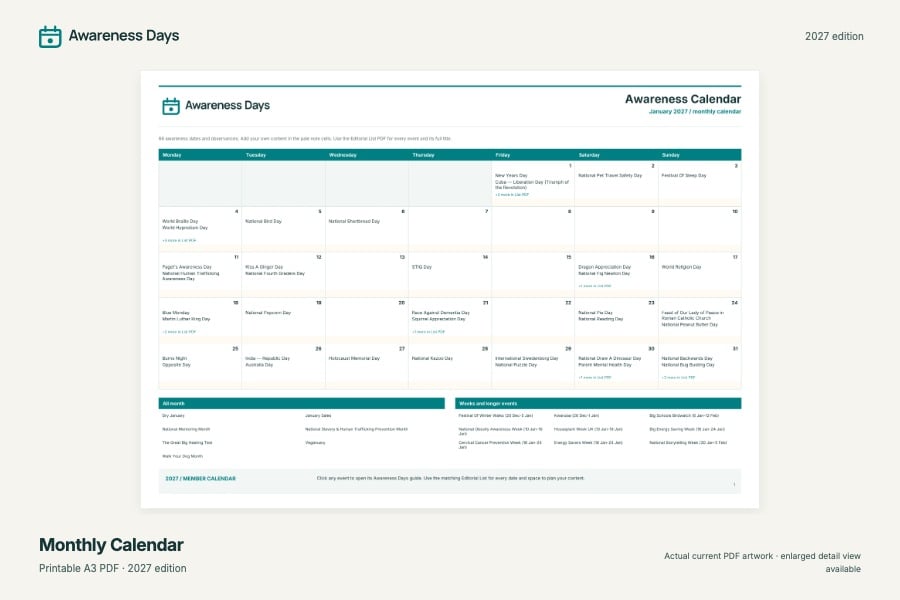
Get the full 2027 awareness days calendar£49.99 a year. Renews annually.
On this page
Dates and event details
Friday 25 September 2026
| Where | US |
|---|
What is National Research Administrator Day?
National Research Administrator Day is an annual appreciation day dedicated to research administrators and managers: the professionals who handle grant applications, budgets, compliance, reporting, and the stewardship of sponsored research funds. These specialists work behind the scenes at universities, teaching hospitals, and research institutes, allowing scientists and faculty to focus on discovery rather than paperwork. The observance was created by NCURA, the leading professional body for the field in the United States, and is marked by institutions around the world. It is a fixed-date occasion, always held on 25 September regardless of the day of the week.
National Research Administrator Day is observed every year on 25 September, recognising the professionals who manage the financial, administrative, and regulatory side of academic and scientific research. In 2026 it falls on Friday, 25 September. The day was established by the National Council of University Research Administrators (NCURA) to thank the people who keep research projects compliant, funded, and on course.
When is National Research Administrator Day?
National Research Administrator Day takes place on Friday, 25 September 2026. The date is fixed: it is observed on 25 September every year, so it never moves. NCURA submitted the day to National Day Calendar in August 2015, and the registrar proclaimed it to be held annually on this date. Because the date is fixed, the day of the week shifts from year to year, but the celebration itself always lands on 25 September.
How to Get Involved in National Research Administrator Day
There are many ways for institutions, departments, and individuals to mark the occasion and show appreciation:
- Say thank you directly – A personal note, email, or message of thanks to the research administrators you work with is the simplest and most meaningful gesture. Acknowledge a specific way they helped a recent project.
- Host a departmental celebration – Organise a coffee morning, lunch, or small gathering so faculty and researchers can recognise the administrators who support them.
- Recognise them publicly – Feature research administrators in a staff newsletter, on the institution’s website, or in a social media post that highlights their contributions.
- Share appreciation online – Post a tribute using the hashtag #ResearchAdministratorDay so colleagues across the sector can join the conversation and amplify recognition.
- Support professional development – Encourage or fund attendance at NCURA training, workshops, or conferences. Investing in skills is a tangible way to value the role.
- Invite them into the research story – Include administrators in project milestones and celebrations, not just the paperwork. Recognising their part in a published study reinforces their impact.
- Mentor newcomers – Experienced administrators can use the day to support those entering the profession, helping build the next generation of the workforce.
- Advocate for the profession – Use the day to raise awareness among senior leadership of the value, complexity, and workload that research administration involves.
Why National Research Administrator Day Matters
Research administration is one of the most consequential roles in modern science that the public rarely hears about. Behind every successful grant lies a professional who navigated complex funding rules, managed multi-million-pound budgets, and ensured the work met legal, ethical, and financial standards. Without these administrators, research funding would stall and institutions would risk costly compliance failures.
The scale of the profession underlines its importance. NCURA alone represents more than 9,000 individual members drawn from over 1,100 colleges, universities, teaching hospitals, and research institutes across 40 countries. Tens of thousands more research administrators work across the United States and internationally, supporting everything from medical trials to climate science. National Research Administrator Day gives institutions a dedicated moment to recognise this often-invisible workforce and the stewardship it provides over public and private research investment.
Noteworthy Facts About National Research Administrator Day
- The day was established in August 2015 when NCURA submitted it to National Day Calendar.
- It is always observed on 25 September, a fixed date that does not move from year to year.
- NCURA, the organisation behind the day, was founded in 1959 and now has more than 9,000 individual members.
- Those members come from over 1,100 colleges, universities, teaching hospitals, and research institutes across 40 countries.
- Research administration as a profession dates back to the 1940s, growing from a handful of staff to a global workforce numbering in the tens of thousands.
Links
History of National Research Administrator Day
Research administration as a distinct profession traces its roots to the 1940s, when a small number of individuals began managing the growing volume of government-sponsored research at American universities. As public and private investment in science expanded through the second half of the twentieth century, so did the need for specialists who could handle grant compliance, financial oversight, and reporting. What started as a handful of roles grew into a global profession numbering in the tens of thousands.
The National Council of University Research Administrators was founded in 1959 to support this emerging field, providing training, networking, and professional standards. Over the following decades NCURA became the central professional body for research administration in the United States, with members and affiliates around the world.
National Research Administrator Day itself is a more recent addition. NCURA submitted the day to National Day Calendar in August 2015, and it was proclaimed to be observed annually on 25 September. Since then, universities, hospitals, and research institutes have used the occasion to formally recognise the professionals who make funded research possible, and adoption of the day has spread well beyond NCURA’s own membership.
Hashtags
Help raise awareness by sharing National Research Administrator Day with your colleagues, faculty, and followers. Use the hashtags #ResearchAdministratorDay and #ResearchAdministratorDay2026 on social media. The more people who recognise the work of research administrators, the more the profession is valued across the research community.
Frequently asked questions
What is National Research Administrator Day?
It is an annual appreciation day, created by NCURA, recognising the research administrators and managers who handle grants, budgets, compliance, and the stewardship of sponsored research funds at universities, hospitals, and research institutes.
When is National Research Administrator Day in 2026?
It falls on Friday, 25 September 2026. The date is fixed every year on 25 September, so only the day of the week changes from one year to the next.
Who created National Research Administrator Day?
The National Council of University Research Administrators (NCURA) submitted the day to National Day Calendar in August 2015, where it was proclaimed to be observed annually on 25 September.
More awareness days in September
See all → 16–22 SepWeek16 Sep to 22 SepWeekScience & TechnologyInternationalNational Coding Week 2026
 21 Sep – 4 OctWeek21 Sep to 4 OctWeekEducation & YouthUK, US, Australia and worldwideFairtrade Fortnight 2026
 25 Sep25 SepFridaySeptember Awareness DaysUK, US, Australia and worldwideInternational Ataxia Awareness Day 202625Sep25 Sep25 SepFridayFood & NutritionUSNational Cooking Day