

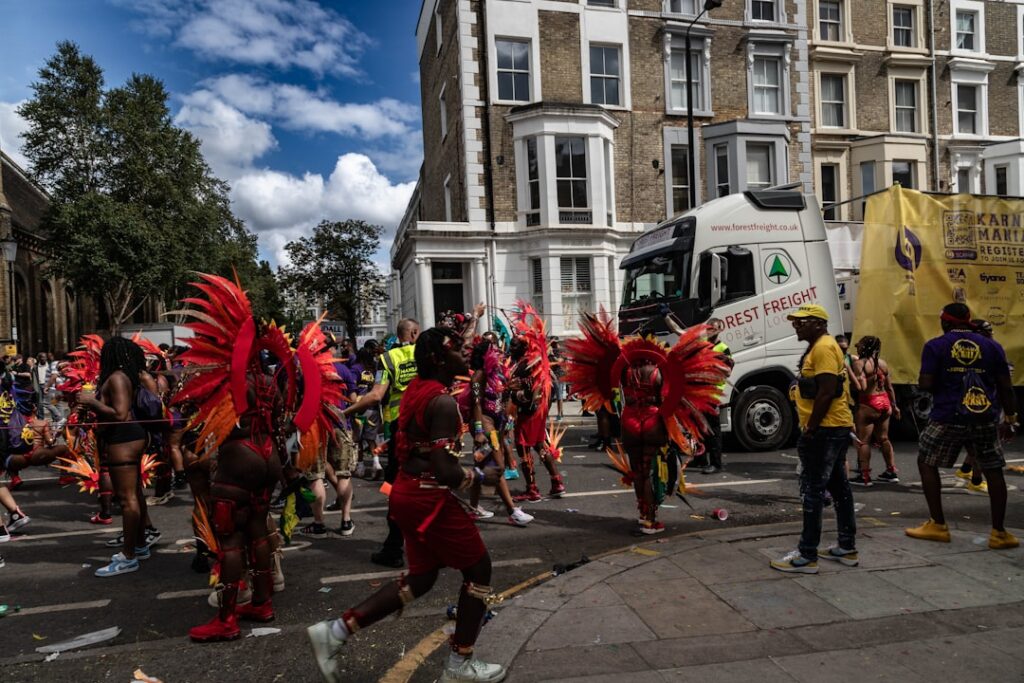
Notting Hill Carnival 2027
Sunday 29 August to Monday 30 August 2027 · dates set by the organiser each year
Notting Hill Carnival is Europe’s largest street festival, drawing around two million visitors to west London each August bank holiday weekend.
Also on 29 August: Jimmy Buffett Day
Notting Hill Carnival Dates
Notting Hill Carnival 2027 runs from Sunday 29 August 2027 to Monday 30 August 2027.
Notting Hill Carnival is Europe’s largest street festival, drawing around two million visitors to west London each August bank holiday weekend. In 2026, the event marks its Diamond Jubilee: sixty years since the first outdoor street procession rolled through Portobello Road in 1966. The carnival is organised by Notting Hill Carnival Ltd, whose CEO Matthew Phillip describes 2026 as “six decades of community turning exclusion into expression, struggle into celebration.”
The carnival spans three days each August bank holiday weekend. Saturday’s Panorama (UK National Steelband Competition) is ticketed; Family Day and Adults Day are free to attend.
| Year | Panorama (Sat) | Family Day (Sun) | Adults Day (Mon) |
|---|---|---|---|
| 2026 | Saturday 29 August | Sunday 30 August | Monday 31 August |
| 2027 | Saturday 28 August | Sunday 29 August | Monday 30 August |
| 2028 | Saturday 26 August | Sunday 27 August | Monday 28 August |
What Happens at the Carnival
Saturday: Panorama
Panorama is the UK’s national steel band competition. Junior Panorama starts at 5pm; the main event follows at 8pm. Tickets sell quickly, and for 2026 the Diamond Jubilee programme includes an extended run of exhibitions and cultural events in the weeks leading up to the weekend.
Sunday: Family Day
J’ouvert opens the day at 6am, with an opening ceremony at 10am. The Children’s Day Parade runs from 10:30am to 5pm along the carnival route, accompanied by sound systems and stages from midday to 7pm. A 72-second Moment of Reflection at 3pm honours victims of the Grenfell Tower fire and other members of the community lost in the past year.
Monday: Adults Day
The Grand Parade, with mas bands in elaborate costume, sets off from 10:30am, moving through Ladbroke Grove, Portobello Road, and Westbourne Grove. Sound systems and stages run from midday to 7pm. Road closures across W10 and W11 are in place from 6am Sunday through to 6am Tuesday, including the A402 corridor.
Plan around Notting Hill Carnival and every key date in August
The Awareness Days Toolkit puts every awareness day for 2026 and 2027 in a spreadsheet, printable PDF calendars and an iCal feed that keeps itself up to date.
How to Attend
- Travel via Paddington. Arrive at Paddington (Elizabeth line, Bakerloo line, or National Rail) and walk. Stations on the carnival route, including Notting Hill Gate, Ladbroke Grove, and Westbourne Park, face severe overcrowding and may close temporarily at peak times.
- Plan your return. There is no Night Tube or Night Overground on Sunday or Monday evenings; plan your journey before the last trains fill.
- Wear trainers. The streets are the venue; expect several hours of walking and standing.
- Use the official app. Notting Hill Carnival Ltd launched a new official app for 2026 with live maps, band locations, and stage timings.
- Accessibility. Guidance on accessible viewing areas and steward support is published at nhcarnival.org before the weekend.
The Mayor of London estimates the carnival contributes around £400 million to London’s economy each year, supported by roughly 40,000 volunteers.
History
Two strands of history converge in Notting Hill Carnival.
The first is the indoor Caribbean Carnival organised by Claudia Jones, a Trinidadian journalist and activist, who staged a BBC-broadcast indoor event at St Pancras Town Hall on 30 January 1959 in direct response to the 1958 Notting Hill race riots. Jones organised annual indoor events until her death in December 1964. She is commemorated with an English Heritage blue plaque and is widely described as the mother of British carnival.
The outdoor tradition began in August 1966, when community activist Rhaune Laslett and the London Free School organised a neighbourhood street fayre. She invited steel pan player Russell Henderson and his band, who spontaneously processed through Portobello Road with their instruments, creating the first carnival parade. Laslett’s stated aim: “We felt that although West Indians, Africans, Irish and many other nationalities all live in a very congested area, there is very little communication between us.”
In 1973, Leslie Palmer introduced multiple static sound systems, shaping the carnival’s sonic character. Attendance reached the millions through the 1990s and 2000s. The full history is documented at nhcarnival.org/experience/history.
Related Dates
Other events around this time include August Awareness Days across the UK, and the wider Arts, Culture and Heritage calendar throughout the year.
Last reviewed: 26 August 2026.
Featured image: Photo by Bernd 📷 Dittrich on Unsplash.




Frequently asked questions
Is Notting Hill Carnival free?
Family Day (Sunday) and Adults Day (Monday) are free to attend. The Saturday Panorama is ticketed. Check nhcarnival.org for ticket information and booking links.
How many people attend?
Around two million people attend across the weekend, making Notting Hill Carnival one of the world’s largest street festivals and the second largest carnival after Rio de Janeiro.
What is the best way to get there?
Arrive at Paddington station via the Elizabeth line, Bakerloo line, or National Rail, then walk to the route. Stations on and near the route often restrict entry during peak times, and driving is not recommended as road closures cover most of W10 and W11.
When did Notting Hill Carnival begin?
The first outdoor street carnival was in August 1966, organised by Rhaune Laslett. The indoor Caribbean Carnival tradition was established earlier, in January 1959, by Claudia Jones at St Pancras Town Hall.
When is Notting Hill Carnival?
Notting Hill Carnival runs from 29 August 2027 to 30 August 2027. It is held dates set by the organiser each year.
More awareness days in August
See all → 30 Aug30 AugMondaySeasonalUKUK Summer Bank Holiday
 8 Aug8 AugSundayAnimals & WildlifeUK, US, Australia and worldwideInternational Cat Day 2027
 19 Aug19 AugThursdayCommunityInternationalWorld Humanitarian Day 2027
 19 Aug19 AugThursdayArts & Culture AwarenessInternationalWorld Photography Day 2027
 23 Aug – 6 SepWeek23 Aug to 6 SepWeekSeasonalInternationalBack to School 2027
 26 Aug26 AugThursdayAnimals & WildlifeInternationalNational Dog Day 2027
 29 Aug29 AugSundayArts & CultureInternationalJimmy Buffett Day
 30 Aug30 AugMondayFood & NutritionUSNational Toasted Marshmallow Day 2027