Passover (Pesach) 2026
April 2 - April 9
About Passover (Pesach) 2026
Passover, known in Hebrew as Pesach, is one of the most significant festivals in Judaism. In 2026, Passover begins at sunset on Wednesday 1 April and continues through Thursday 9 April for Jewish communities in the Diaspora, or until Wednesday 8 April in Israel. The festival commemorates the liberation of the Israelites from slavery in ancient Egypt and is observed through the Seder meal, the reading of the Haggadah, and the removal of all leavened bread from the home.
What is Passover?
Passover is an eight-day festival (seven days in Israel) that marks the defining moment in Jewish history: the Exodus from Egypt. The name “Passover” refers to God “passing over” the homes of the Israelites during the tenth plague, when the firstborn of Egypt were struck down. Jewish families had marked their doorposts with the blood of a sacrificed lamb, and their households were spared.
The festival begins on the 15th day of Nisan in the Hebrew calendar, which typically falls in March or April in the Gregorian calendar. Because the Hebrew calendar is lunisolar, Passover’s dates shift each year relative to the standard Western calendar. Passover is one of the three pilgrimage festivals (along with Shavuot and Sukkot) during which, in ancient times, Jews would travel to the Temple in Jerusalem.
When is Passover in 2026?
In 2026, Passover begins at sunset on Wednesday 1 April and ends after nightfall on Thursday 9 April for communities outside Israel. In Israel, the festival concludes a day earlier, on Wednesday 8 April. The first Seder takes place on the evening of Wednesday 1 April, and the second Seder (observed outside Israel) falls on the evening of Thursday 2 April.
Passover moves each year according to the Hebrew lunisolar calendar. The table below shows upcoming dates for the Diaspora (eight-day observance):
| Year | Dates (Diaspora) |
|---|---|
| 2025 | 13–20 April |
| 2026 | 2–9 April |
| 2027 | 22–29 April |
| 2028 | 11–18 April |
| 2029 | 31 March – 7 April |
The Story of the Exodus
The narrative at the heart of Passover is told in the Book of Exodus. According to the Torah, the Israelites had lived in Egypt for over four hundred years. What began as a period of prosperity under Joseph’s influence eventually gave way to brutal enslavement under a new Pharaoh who feared the growing Israelite population.
God chose Moses to lead the Israelites to freedom. When Pharaoh repeatedly refused to release the slaves, God sent ten plagues upon Egypt — from rivers turning to blood to swarms of locusts and days of darkness. The tenth and most devastating plague was the death of every firstborn Egyptian. God instructed the Israelites to mark their doorposts with lamb’s blood so that the plague would “pass over” their homes. This act of faith and divine protection gave the festival its name.
When Pharaoh finally relented, the Israelites fled in such haste that their bread dough had no time to rise. This is why matzah — flat, unleavened bread — is eaten throughout Passover, and why all chametz (leavened products) is removed from Jewish homes before the festival begins.
The Seder Meal
The centrepiece of Passover observance is the Seder, a ritual meal held on the first evening of the festival (and repeated on the second evening outside Israel). The word “Seder” means “order” in Hebrew, reflecting the carefully structured sequence of prayers, readings, songs, and symbolic foods that guide participants through the story of the Exodus.
The Haggadah — literally meaning “the telling” — is the text read aloud during the Seder. It recounts the slavery in Egypt, the ten plagues, and the miraculous liberation. One of the most memorable moments is when the youngest person at the table asks the Four Questions, beginning with “Why is this night different from all other nights?” The answers unfold through the rest of the evening.
The Seder also includes drinking four cups of wine (or grape juice), each representing a different divine promise of redemption. A fifth cup, the Cup of Elijah, is poured but left untouched, symbolising hope for future redemption and the coming of the Messiah. In many households, the door is briefly opened to welcome the prophet Elijah.
Symbolic Foods on the Seder Plate
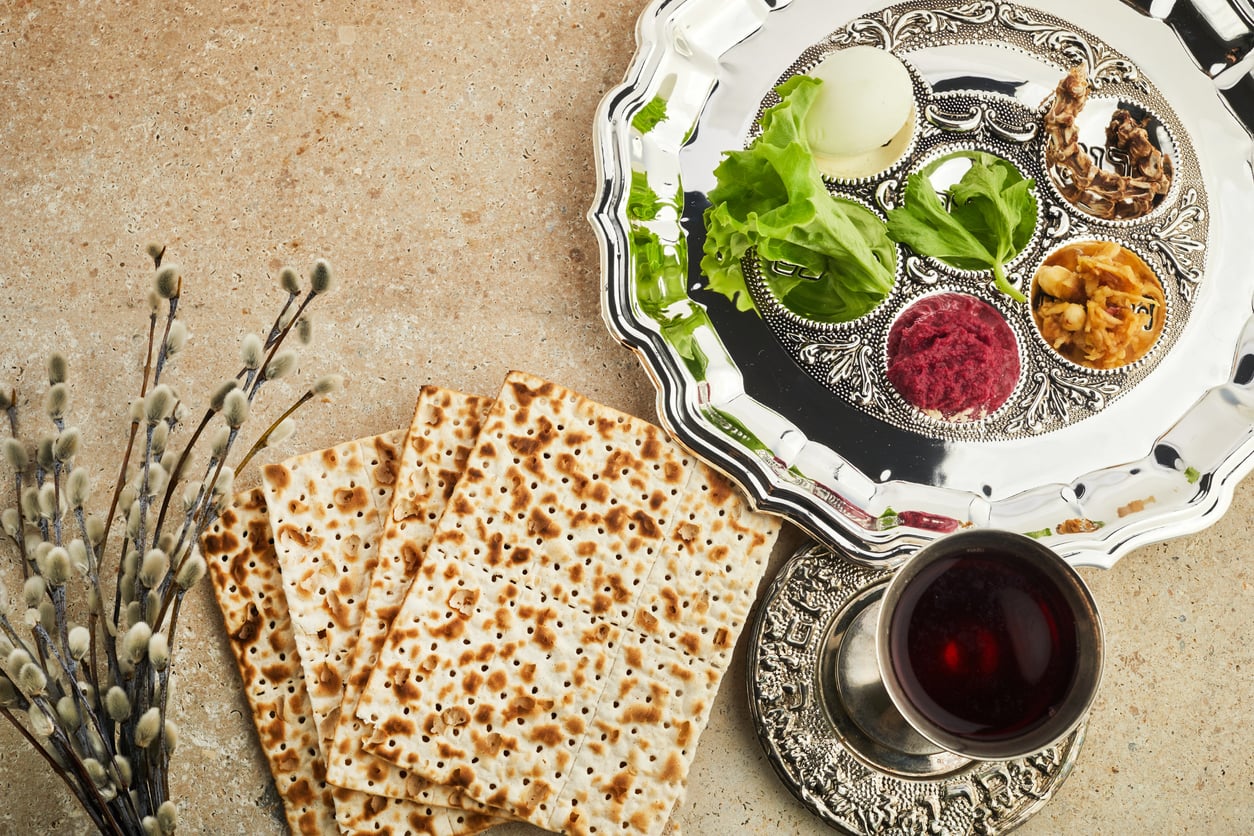
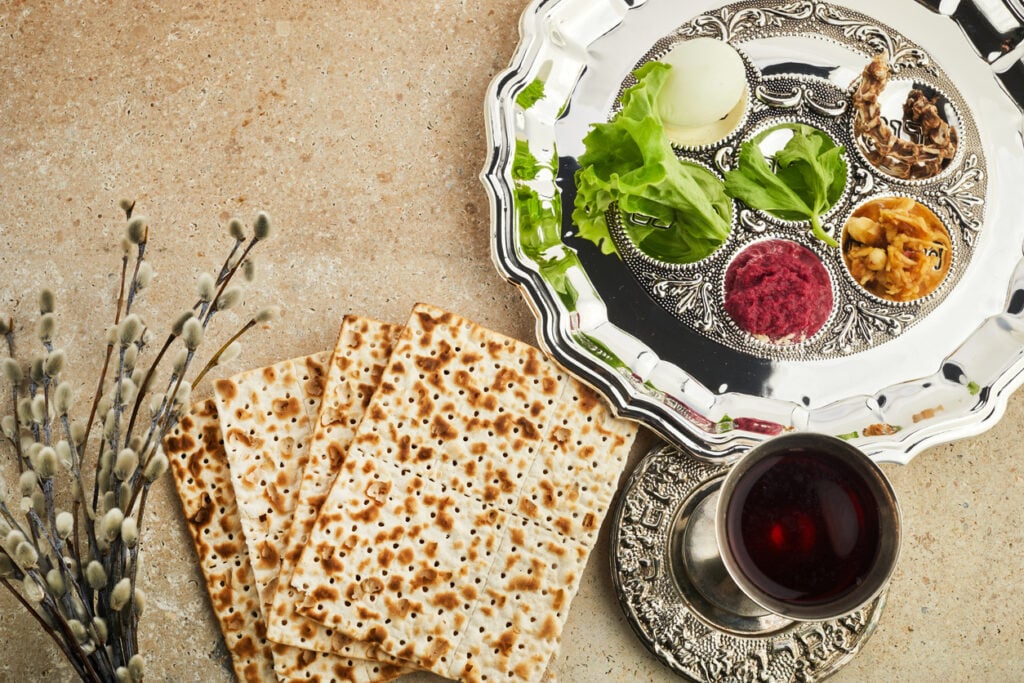
The Seder plate (ke’arah) holds six symbolic items, each carrying deep meaning:
- Matzah — Three sheets of unleavened bread recall the haste of the Exodus. The middle matzah is broken during the Seder; one half becomes the afikomen, which is hidden for children to find later in the evening.
- Maror (bitter herbs) — Typically horseradish or romaine lettuce, maror represents the bitterness of slavery. It is dipped in charoset before eating.
- Charoset — A sweet paste made from apples, nuts, wine, and spices (recipes vary widely by community). Its texture resembles the mortar the Israelite slaves used to build Pharaoh’s structures.
- Karpas (green vegetable) — Usually parsley or celery, dipped in salt water at the start of the Seder. The vegetable symbolises spring and renewal, while the salt water represents the tears shed during slavery.
- Zeroa (shankbone) — A roasted lamb shankbone (or chicken neck) represents the Paschal sacrifice offered at the Temple in Jerusalem. It is placed on the plate but not eaten.
- Beitzah (roasted egg) — A hard-boiled egg, roasted until its shell browns, symbolises the festival sacrifice and the cycle of life. Some interpret it as a reminder of mourning for the destroyed Temple.
How Passover is Observed Today
In the weeks leading up to Passover, Jewish families undertake a thorough cleaning of their homes to remove every trace of chametz — any food made from wheat, barley, rye, oats, or spelt that has been allowed to rise. Cupboards are emptied, kitchens are scrubbed, and separate sets of Passover-specific dishes and cookware are brought out. On the evening before the Seder, many households conduct a ceremonial search for chametz (bedikat chametz) by candlelight.
Throughout the eight days of Passover (seven in Israel), observant Jews refrain from eating or owning chametz. Matzah replaces bread, and meals are prepared using Passover-approved ingredients. Many families follow additional customs passed down through generations, from specific recipes to particular melodies sung during the Seder.
Synagogue services during Passover include special prayers, Torah readings recounting the Exodus, and the recitation of Hallel (psalms of praise). The seventh day of Passover commemorates the crossing of the Red Sea, while the final day focuses on themes of future redemption.
Passover Around the World
Passover is observed by Jewish communities in virtually every country, though traditions vary by region and cultural heritage. In Israel, Passover is a national holiday. Schools and many businesses close, and families gather for a single Seder on the first night. The festival lasts seven days, and the intermediate days (Chol HaMoed) are a popular time for travel and family outings.
In the United States, home to the world’s largest Jewish population outside Israel, Passover Seders are among the most widely observed Jewish rituals — even among secular Jews. The White House has hosted an annual Seder since 2009. American Seders often incorporate contemporary themes of social justice and freedom alongside traditional readings.
In the United Kingdom, the Jewish community — concentrated primarily in London, Manchester, and Leeds — celebrates with both Orthodox and Progressive traditions. Communal Seders organised by synagogues and Jewish organisations welcome those without family nearby. British supermarkets stock dedicated Passover sections in the weeks before the festival.
In Australia, where the Jewish community numbers around 120,000, Passover falls during autumn rather than spring, giving the festival a different seasonal character. Cities such as Melbourne and Sydney host large communal Seders, and Chabad centres across the country offer public celebrations for anyone wishing to participate.
Sephardi and Mizrahi communities — Jews with roots in Spain, North Africa, and the Middle East — follow distinct culinary traditions during Passover. Their Seders may feature rice, legumes, and spiced dishes that differ markedly from the Ashkenazi customs more familiar in Europe and North America.
The Connection Between Passover and Easter
Passover and Easter share deep historical roots. Many scholars believe that the Last Supper, the meal Jesus shared with his disciples before his crucifixion, was a Passover Seder. The word “Pascha,” used for Easter in many European languages (French: Paques, Italian: Pasqua, Spanish: Pascua), derives directly from the Hebrew word Pesach.
In 2026, the two festivals overlap closely. Passover begins on the evening of 1 April, while Good Friday falls on 3 April and Easter Sunday on 5 April. However, the dates do not always align so neatly. Passover follows the Hebrew lunisolar calendar, while Easter is calculated as the first Sunday after the first full moon on or after the spring equinox — a rule established at the Council of Nicaea in 325 CE. In some years, the two festivals can fall as much as five weeks apart.
Frequently Asked Questions
What is Passover?
Passover (Pesach) is a major Jewish festival commemorating the liberation of the Israelites from slavery in ancient Egypt. It is observed through the Seder meal, the reading of the Haggadah, and the avoidance of all leavened bread for eight days (seven in Israel).
When is Passover in 2026?
Passover 2026 begins at sunset on Wednesday 1 April and ends after nightfall on Thursday 9 April for communities outside Israel. In Israel, it concludes on Wednesday 8 April.
Why do Jews eat matzah during Passover?
Matzah commemorates the Israelites’ hurried departure from Egypt. They left so quickly that their bread dough had no time to rise, resulting in flat, unleavened bread. Eating matzah throughout Passover serves as a tangible reminder of that moment of liberation.
How long does Passover last?
Passover lasts eight days for Jewish communities outside Israel (the Diaspora) and seven days within Israel. The difference stems from ancient calendar uncertainties — communities far from Jerusalem added an extra day to ensure they observed the correct dates.
Spread the Word
Help others learn about Passover by sharing this page with friends, family, and colleagues. Use the hashtags #Passover, #Pesach, and #Passover2026 on social media. Whether you are hosting a Seder, attending one for the first time, or simply learning about Jewish traditions, every conversation helps foster understanding and respect across communities.
Related Awareness Days
- Easter Sunday 2026 — Falling on 5 April 2026, Easter shares historical roots with Passover and marks the Christian celebration of the resurrection of Jesus.
- Good Friday — Observed on 3 April 2026, Good Friday commemorates the crucifixion of Jesus, an event closely linked to the Passover narrative in Christian theology.
- Eid al-Adha — One of the most important festivals in Islam, Eid al-Adha honours the willingness of Ibrahim (Abraham) to sacrifice his son — a figure shared across Judaism, Christianity, and Islam.
Links
- Visit the Chabad.org Passover guide
- Passover at Reform Judaism
- Passover at My Jewish Learning
- Explore more awareness days at AwarenessDays.com
Plan your next campaign
Use Awareness Planner to discover events, build content calendars, and stay ahead of key dates.







2026 Awareness Days Wall Planner
Every key awareness day at a glance. Perfect for offices, staff rooms, and team planning.
View Calendar →