
Burns Night 2027
Monday 25 January 2027
Burns Night is Scotland’s informal second national day, after St Andrew’s Day on 30 November; it is the one people sit down to dinner for.
Add this date to my calendarA full year of awareness dates, ready to edit or print.
Get the full 2027 awareness days calendar£29 once. No automatic renewal.
On this page
Dates and event details
Burns Night 2027 is on Monday 25 January 2027. It falls on 25 January every year.
| Year | Date |
|---|---|
| 2027 | Monday 25 January 2027 |
| 2028 | Tuesday 25 January 2028 |
| 2029 | Thursday 25 January 2029 |
| Where | UK |
|---|
What is Burns Night?
Burns Night is Scotland’s informal second national day, after St Andrew’s Day on 30 November; it is the one people sit down to dinner for. Hotels, restaurants, village halls and Burns clubs across Scotland hold suppers through the second half of January, and because 25 January 2027 is a Monday, many will move their event to the nearest weekend. Suppers are also held across the rest of the UK and wherever Scots have settled, from Canada to Australia. Burns Night is not a bank holiday anywhere in the UK, so it is a working day with the celebration in the evening.
Burns Night, also called Burns Day, Robert Burns Day or Rabbie Burns Night, celebrates the life and work of Robert Burns, Scotland’s national poet, on the anniversary of his birth on 25 January 1759. The centrepiece is the Burns Supper: a meal of haggis, neeps and tatties, with poems, speeches, toasts and song in a running order that has barely changed in two centuries. Nobody owns the night. It is a folk tradition kept alive by Burns clubs, pubs, schools and families, and the clearest official guides come from VisitScotland and the Scottish Government’s Scotland.org.
How to take part
At home. You do not need a piper or a top table. Cook a haggis, print out the Selkirk Grace and the first verse of “Address to a Haggis”, ask one guest to say a few words about Burns and finish with “Auld Lang Syne”.
In schools. Primary classes learn “To a Mouse” or a verse of the Address, try haggis at lunch, hold a ceilidh in the hall or run a Scots-language poetry recital. Burns is a natural way into poetry writing for older pupils.
At work. A haggis lunch or a Burns-themed quiz is an easy January team event, and pubs and hotels across the UK run ticketed suppers through the month. If you are booking one, look for an event with the full programme of speeches rather than just the meal.
Who was Robert Burns?
Robert Burns was born in Alloway, Ayrshire, on 25 January 1759, the son of a tenant farmer. He farmed for most of his life, in Ayrshire and later near Dumfries, before taking a post as an exciseman. His first collection, Poems, Chiefly in the Scottish Dialect, was printed in Kilmarnock in 1786 and made him famous almost overnight. In his later years he collected and rewrote traditional Scottish songs, which is how “Auld Lang Syne” and “A Red, Red Rose” came down to us. He died in Dumfries on 21 July 1796, aged 37. He wrote in Scots and English about farming, poverty, love, religion and politics, usually on the side of the underdog, and “To a Mouse”, “Tam o’ Shanter” and “A Man’s a Man for a’ That” are among the works most often read aloud on Burns Night.
How Burns Night began
The first Burns Supper was held on 21 July 1801, the fifth anniversary of the poet’s death, when nine of his friends met at Burns Cottage in Alloway to eat haggis and sheep’s head and read his verse. According to the National Records of Scotland, that first dinner already contained the essentials: an address to the haggis, a toast to Burns’s “Immortal Memory”, good food and drink, and readings of his work. The friends met again the following January on his birthday, and the date stuck. Burns clubs spread quickly through Scotland, and the format they settled on is the one still used today. The cottage where it all started is now part of the Robert Burns Birthplace Museum in Alloway, run by the National Trust for Scotland.
The running order of a Burns Supper
A formal Burns Supper follows a set programme. Home suppers trim it, but the bones are the same:
- Piping in the guests. A piper plays as guests take their seats, and the host says a few words of welcome.
- The Selkirk Grace. A short grace in Scots, said before anything is eaten (the words are below).
- Piping in the haggis. The haggis is carried in on a platter, led by a piper, and the room stands to applaud it to the top table.
- Address to a Haggis. A guest recites Burns’s poem to the haggis, plunging a knife into it at the line “An’ cut you up wi’ ready slight”. A toast to the haggis follows, usually with whisky.
- The meal. Traditionally cock-a-leekie or Scotch broth to start, haggis with neeps (swede) and tatties (potatoes) as the main course, and cranachan or clootie dumpling to finish.
- The Immortal Memory. The main speech of the night. A speaker talks about Burns’s life and work for ten or fifteen minutes and ends with the toast “To the Immortal Memory of Robert Burns”.
- Toast to the Lassies and the Reply. Originally a thank-you to the women who cooked, now a light-hearted speech about women given by a man and answered in kind by a woman. Both should be funny and short.
- Songs and recitations. Guests perform Burns’s poems and songs between the speeches.
- Vote of thanks and Auld Lang Syne. The host thanks the speakers and everyone stands, crosses arms, joins hands and sings “Auld Lang Syne” to close.
The Selkirk Grace and the Address to a Haggis
The Selkirk Grace is four lines long and is the easiest part of the night for a nervous host:
Some hae meat and canna eat,
And some wad eat that want it;
But we hae meat, and we can eat,
Sae let the Lord be thankit.
It is usually attributed to Burns, who is said to have given it at a dinner held by the Earl of Selkirk, although versions were known in Galloway before his time. “Address to a Haggis” is unquestionably his: he wrote it in 1786 and it was first printed in the Caledonian Mercury that year, according to the Scottish Poetry Library. It runs to eight verses and opens:
Fair fa’ your honest, sonsie face,
Great Chieftain o’ the Puddin-race!
Aboon them a’ ye tak your place,
Painch, tripe, or thairm:
Weel are ye wordy of a grace
As lang ‘s my arm.
It is traditional to recite the whole poem from memory, with plenty of theatre. If nobody at your table is up to that, reading the first and last verses is a respectable compromise.
What to eat and drink
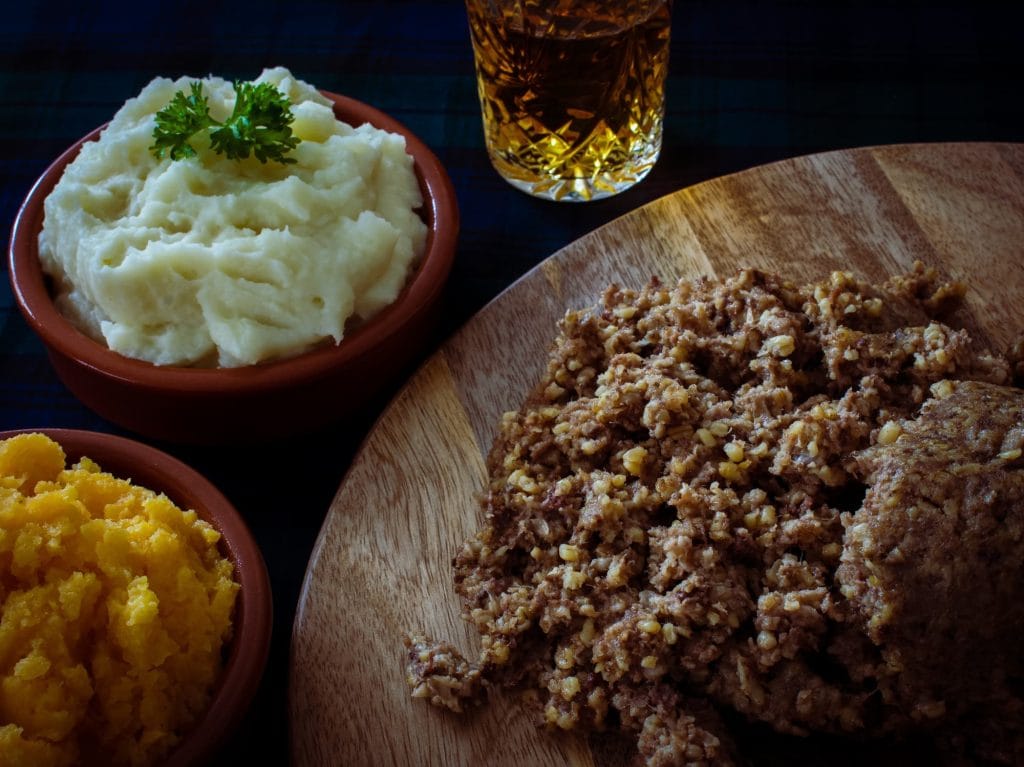
Haggis is a savoury pudding of sheep’s offal, oatmeal, onion, suet and spices. UK supermarkets and butchers stock it in January, and vegetarian haggis works just as well with the ceremony. It is served with neeps (mashed swede) and tatties (mashed potato), often with a whisky sauce. Cock-a-leekie or Scotch broth makes a good starter, and cranachan, a mix of cream, raspberries, toasted oats, honey and whisky, is the classic pudding. Whisky is the traditional drink for the toasts, but it is not compulsory; schools and workplaces generally toast with soft drinks.
Frequently asked questions
When is Burns Night 2027?
Burns Night 2027 is on Monday 25 January 2027. It is held on 25 January every year because that is Robert Burns’s birthday.
What day is Burns Night on?
Always 25 January, whatever day of the week that is. In 2027 it is a Monday, in 2028 a Tuesday and in 2029 a Thursday. Public suppers are often held on the nearest weekend.
Is Burns Night a bank holiday?
No. Burns Night is not a public holiday in Scotland or anywhere else in the UK. Scotland’s bank holiday for its national day is St Andrew’s Day on 30 November.
What is the difference between Burns Night, Burns Day and Robbie Burns Day?
They are the same event. Burns Night is the usual name in the UK, while Robbie Burns Day and Robert Burns Day are more common in Canada and the United States. Rabbie, not Robbie, is the Scots form of the name.
What happens at a Burns Supper?
Guests are piped in, the Selkirk Grace is said, the haggis is piped in and addressed, and a meal of haggis, neeps and tatties follows. After dinner come the Immortal Memory speech, the Toast to the Lassies and its Reply, songs and poems, and “Auld Lang Syne” to finish.
Why is haggis eaten on Burns Night?
Because Burns wrote “Address to a Haggis” in its honour, and because haggis was on the table at the very first Burns Supper in 1801. Reciting the poem over the haggis has been the heart of the night ever since.