International Day Against Unilateral Coercive Measures 2026
Friday 4 December 2026
Dates can vary from year to year, so check the organiser’s website for the latest details.
The UN observance on 4 December examines unilateral coercive measures, international cooperation and their effects on people and development.
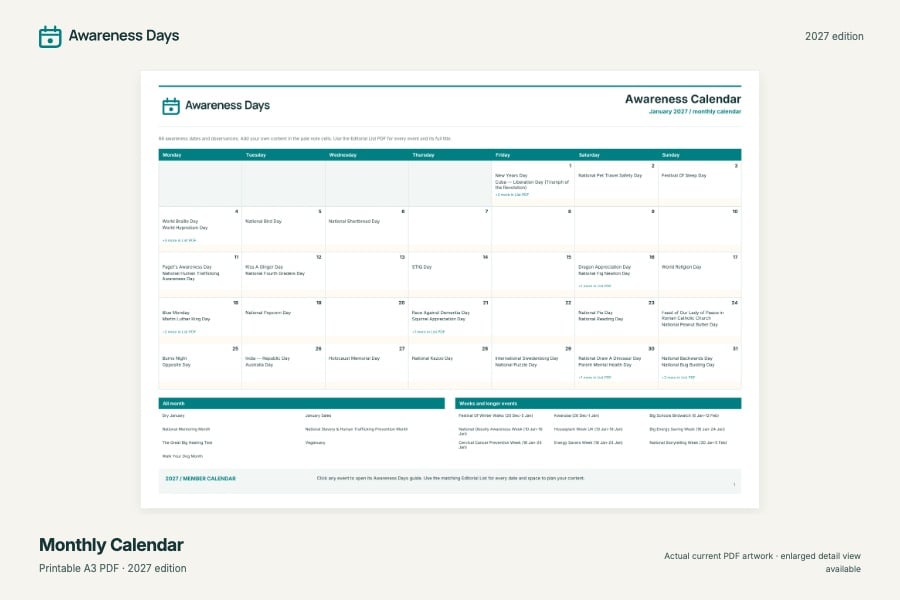
Add this date to my calendarA full year of awareness dates, ready to edit, print or sync.
Get the full 2027 awareness days calendar£49.99 a year. Renews annually.
On this page
Dates and event details
Friday 4 December 2026. Held every year on 4 December.
| Date status | Date calculated from a fixed annual pattern |
|---|---|
| Date-check source | Official observance organiser |
| Where | International |
What is the day about?
The General Assembly established the observance in 2025 through resolution A/RES/79/293. Its focus includes the consequences that such measures can have for people, economic activity and sustainable development. The date provides an opportunity to examine the UN’s stated position, the language of the resolution and the experiences being discussed.
This is a subject on which governments hold different views. Accurate coverage should distinguish the observance’s specific focus from measures taken under the UN Charter. The existence of the day does not, by itself, settle the legal status of any particular restriction, transaction or national policy.
The International Day Against Unilateral Coercive Measures is observed annually on 4 December, including Friday 4 December 2026. It is a United Nations occasion for discussing international cooperation and the effects of unilateral measures that the General Assembly identifies as inconsistent with international law and the UN Charter.
Ideas for schools and universities
- Build a glossary. Explore terms such as multilateralism, the UN Charter, humanitarian exemptions and sustainable development using appropriate official educational material.
- Map different responsibilities. Examine how the General Assembly, Security Council, governments and humanitarian organisations have different roles. Avoid treating them as one decision-making body.
- Study a documented development question. Consider how access to transport, banking or supplies can affect a community, using a clearly attributed case study rather than an invented example presented as fact.
- Practise evidence-based discussion. Give participants time to prepare, require sources for factual claims and allow them to revise a view when new information is introduced.
Workplace and community activities
A library, university society or community organisation could host a chaired discussion with someone who understands the relevant international institutions. Publish the scope and intended audience beforehand. Make clear whether the session is educational, an examination of a particular document or a presentation by an invited speaker.
Businesses with international operations can use the date for general learning about the institutions that shape cross-border activity. Any operational question about sanctions, payments or trade should go through the organisation’s established professional advice and compliance channels. A calendar activity is not a source of transaction-specific instructions.
Community programmes can also consider how to discuss international affairs without placing responsibility on local people because of their nationality or family background. Invite contributions voluntarily, provide accessible materials and keep a distinction between criticism of a policy and treatment of individuals.
Start with the primary documents
A useful activity begins by reading the official UN background and identifying the questions it raises. What does the resolution ask Member States and organisations to do? Which effects does it discuss? Which terms require further explanation? Keeping those questions visible helps a discussion move beyond slogans.
For older students, compare a General Assembly resolution with an explanatory UN statement. Identify the author, publication date and purpose of each. Ask participants to separate what a document expressly says from their interpretation of it, and to recognise where they would need specialist knowledge before reaching a conclusion.
Make the outcome useful
Choose a modest result: an annotated reading list, an improved understanding of UN terminology or a list of questions for a future seminar. Record where speakers disagree and what evidence would help clarify the issue. Make the references available in advance so participants can check quotations and prepare questions of their own. A careful account of an unresolved question can be a worthwhile outcome.
Related learning can connect with Human Rights Day and the International Day of Peace.
Source check: 23 October 2026. The name, annual date and designation were checked against the official UN observance page. No particular 2026 theme or meeting programme is assumed.