

International Day of Human Fraternity 2027
Thursday 4 February 2027
Dates can vary from year to year, so check the organiser’s website for the latest details.
International Day of Human Fraternity on 4 February promotes dignity, mutual understanding and dialogue across religious and cultural differences.
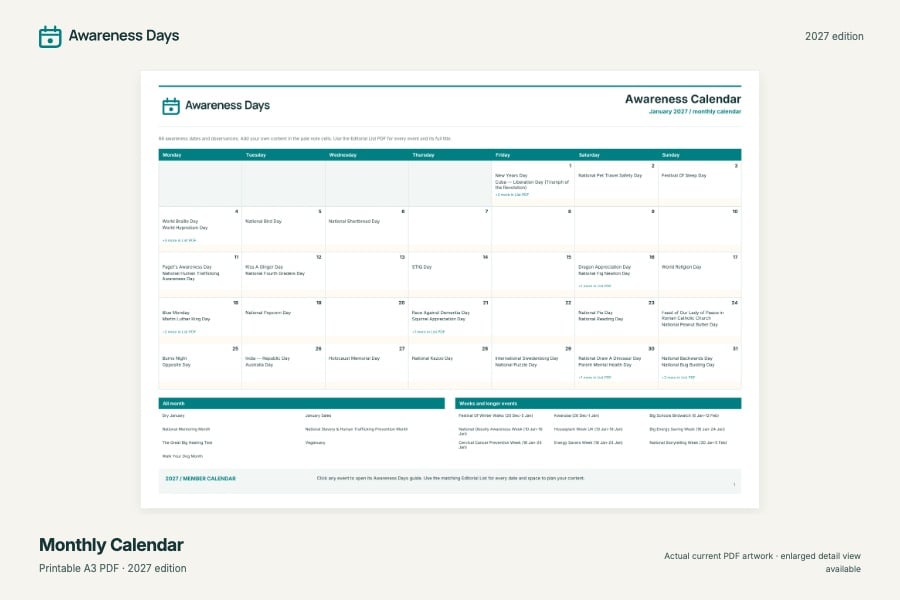
Add this date to my calendarA full year of awareness dates, ready to edit, print or sync.
Get the full 2027 awareness days calendar£49.99 a year. Renews annually.
On this page
Dates and event details
Thursday 4 February 2027. Held every year on 4 February.
| Date status | Date calculated from a fixed annual pattern |
|---|---|
| Date-check source | Official UN or UN agency source |
| Where | International |
About International Day of Human Fraternity
The International Day of Human Fraternity is observed annually on 4 February, including Thursday 4 February 2027. This United Nations day promotes dignity, mutual understanding and solidarity. It offers a focus for dialogue across religious and cultural differences and for practical work that helps people participate on equal terms.
Ideas for schools and colleges
- Read a suitable primary source. Introduce the UN resolution or the background to the 2019 document, explaining who produced it and why.
- Practise respectful dialogue. Ask learners to listen, summarise another person’s point and distinguish a question from an assumption.
- Review a welcome. Consider what a new pupil or visitor needs to know and whether the information is easy to understand.
- Plan a shared contribution. Choose a practical group task and agree how participants will share decisions, responsibilities and recognition.
Workplace activities
A workplace can invite optional feedback about the everyday arrangements that affect inclusion. Consider how meetings are organised, how new colleagues find support and how people can raise a concern. Use existing policies and responsible teams to turn relevant suggestions into clear decisions.
A staff discussion could explore the difference between curiosity and expecting someone to explain an entire culture or religion. An invited speaker should define their own area of expertise, and colleagues should be able to contribute without disclosing personal beliefs. Publish the session’s purpose so that people know what to expect.
Organisations working with community partners can also review whether those relationships are reciprocal. Ask partners what they need, recognise their preparation and agree how decisions are made. A useful partnership has responsibilities on both sides and does not depend only on a yearly publicity moment.
Community activities and follow-up
A library, community centre or local group could host a discussion or practical project with another organisation. Begin with a shared interest and agree arrangements for access, food, travel, timing and costs. Those details help turn a welcoming intention into an event people can actually attend.
At the end, identify one action and the person responsible for it. Tell participants when they will hear about progress, and ask whether the format allowed them to take part comfortably. Continued contact and clear feedback can help a small activity develop into a useful relationship over the following months.
Related dates include Human Rights Day and International Human Solidarity Day.
Source check: 23 October 2026. The annual date and background were verified against UN resolution A/RES/75/200 and official UN messages. No 2027 theme is assumed.
Why 4 February?
The General Assembly proclaimed the day through resolution A/RES/75/200 in December 2020, with annual observance beginning in 2021. The date recalls the signing in Abu Dhabi on 4 February 2019 of the document on human fraternity by Pope Francis and the Grand Imam of Al-Azhar, Ahmad al-Tayyib.
The UN resolution connects the observance with a culture of peace, tolerance, inclusion, understanding and solidarity. The 2027 calendar date follows the standing annual rule. No official 2027 theme or programme has been verified for this guide.
What can human fraternity mean in practice?
An activity can explore how people recognise one another’s dignity while holding different beliefs and experiences. Start with a setting participants know: a school, workplace, shared public space or community organisation. Ask what helps people feel welcome and what prevents them from contributing.
Keep the discussion specific enough to lead somewhere. A broad statement of goodwill may be a useful introduction, but a clear change to an invitation, a meeting or a shared project gives participants something they can assess. Make sure the people affected have a say in defining the problem and the response.