International Lead Poisoning Prevention Week 2026
Sunday 18 October to Saturday 24 October 2026
International Lead Poisoning Prevention Week runs 18–24 October 2026, highlighting action to identify and prevent lead exposure.
Add this date to my calendarA full year of awareness dates, ready to edit, print or sync.
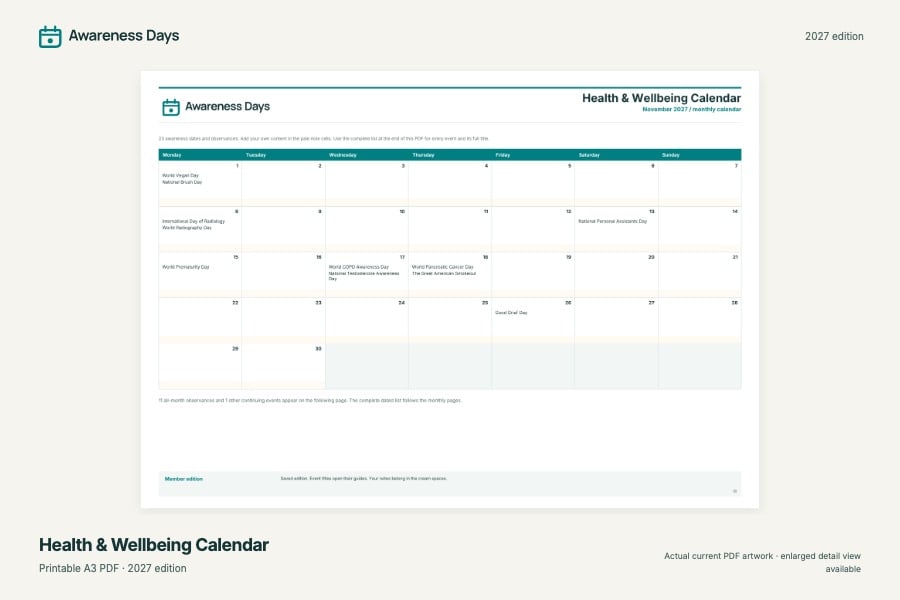
Get the full 2027 health calendar£49.99 a year. Renews annually.
On this page
Dates and event details
Sunday 18 October to Saturday 24 October 2026. Held dates set by the organiser each year.
| Date status | Date source-confirmed for 2026 |
|---|---|
| Date-check source | World Health Organization |
| Where | International |
What is the campaign about?
The 2026 theme links identifying exposure with action to prevent further harm. WHO’s campaign page explains that lead exposure can arise from different sources and may not be visible. The broader campaign includes attention to lead paint and efforts by governments and partners to prevent exposure.
WHO’s October 2026 update identifies the need for action on products, environments, regulation and monitoring. For a local awareness activity, distinguish that public health agenda from advice about an individual property, product or person’s health. Those questions need the relevant qualified services and current local guidance.
When is International Lead Poisoning Prevention Week?
The official WHO 2026 page explicitly gives 18–24 October 2026. The campaign takes place in October, but the date range varies between editions. Do not reuse an older year’s dates or assume a permanent annual range.
The campaign is also described as International Lead Poisoning Prevention Week of Action and abbreviated to ILPPW. This international observance is distinct from nationally organised lead awareness campaigns, whose dates may differ. A 2027 date has not been verified for this listing.
This year's campaign
International Lead Poisoning Prevention Week takes place from 18 to 24 October 2026. The global campaign draws attention to lead exposure and action to prevent it, with particular concern for children’s health. WHO’s confirmed 2026 campaign is the fourteenth edition and uses the theme From Detection to Prevention.
Ideas for schools and community learning
Plan the topic with an appropriate teacher, public health professional or environmental health contact. Suggested educational activities include:
- Explore how a public health warning is communicated. Compare an official source with an unsourced claim and identify what makes the first easier to verify.
- Investigate a prevention programme. Choose a published case study and identify the organisations involved, the problem they addressed and the limits of the information available.
- Create a local information map. Find the official organisations that answer relevant environmental, product safety or health questions in your area.
- Prepare questions for an expert. Ask what information they need when assessing a concern and how members of the public can use the appropriate contact route.
Keep activities focused on information and questions. Do not bring potentially hazardous materials into a classroom or community session as demonstration objects. Use photographs, fictional examples or official published resources where a visual explanation is useful.
Ideas for organisations and workplaces
Identify which team owns relevant responsibilities in your organisation. A useful awareness activity might review where staff find current procedures, how concerns are passed to the responsible person or how approved information reaches contractors and volunteers.
Give the discussion a practical scope. If it raises a technical question, record it for a competent professional rather than asking a group to improvise an answer. An awareness event is a way to improve understanding and communication; it does not replace an assessment, investigation or established safety process.
Sharing accurate campaign material
Label all materials with the year and use the verified 18–24 October range for 2026. Link to the official campaign page so that people can find updated information. Use plain language and explain abbreviations such as ILPPW rather than assuming that every reader knows them.
When describing a project, separate the action already completed from an ambition or planned next step. If sharing a community story, check permissions for the wording and images, and avoid implying that one experience represents every location.
Frequently asked questions
When is International Lead Poisoning Prevention Week 2026?
What is International Lead Poisoning Prevention Week 2026?
More awareness days in October
See all → 31 Oct31 OctSaturdaySeasonalUK, US, Australia and worldwideHalloween
 1–31 OctMonth1 Oct to 31 OctMonthCommunityUKBlack History Month
 1–31 OctMonth1 Oct to 31 OctMonthCancerUK, US, Australia and worldwideBreast Cancer Awareness Month 2026
 1 Oct1 OctThursdayFood & NutritionUK, US, Australia and worldwideInternational Coffee Day 2026