

Spring Equinox (First Day of Spring) 2027
Saturday 20 March 2027
The spring equinox, also called the vernal equinox or March equinox, is the moment the Sun crosses the celestial equator heading north. In the words of the Royal Observatory Greenwich, it is when “Earth’s axis is neither tilted towards or away from the Sun”, so both hemispheres receive sunlight equally.
Add this date to my calendarA full year of awareness dates, ready to edit, print or sync.
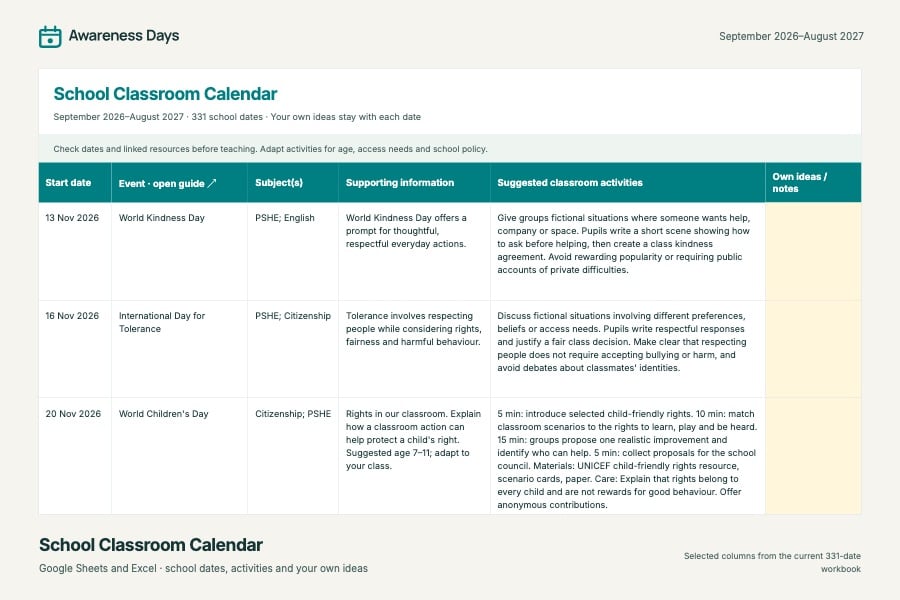
Get the full 2027 school calendar£39 a year. Renews annually.
On this page
Dates and event details
Spring Equinox (First Day of Spring) 2027 is on Saturday 20 March 2027.
| Where | UK |
|---|
What is the spring equinox?
The spring equinox, also called the vernal equinox or March equinox, is the moment the Sun crosses the celestial equator heading north. In the words of the Royal Observatory Greenwich, it is when “Earth’s axis is neither tilted towards or away from the Sun”, so both hemispheres receive sunlight equally. In the Northern Hemisphere it marks the start of astronomical spring; south of the equator the same moment is the autumn equinox.
The word comes from the Latin equi (equal) and nox (night), because day and night are roughly the same length everywhere on Earth. It is a single instant rather than a whole day, which is why it has a clock time as well as a date. In 2027 that instant is 20:25 GMT on 20 March, so the equinox arrives in the evening for the UK.
Nobody organises the equinox. It is an astronomical event tracked by observatories and almanac offices; for the UK, the Royal Observatory Greenwich speaks for the astronomy and the Met Office for the seasons as measured and forecast.
There are two answers to “when does spring start?” and both are correct. Astronomical spring begins at the spring equinox, which in 2027 falls on Saturday 20 March at 20:25 GMT. Meteorological spring, the definition the Met Office uses for weather records, always begins on 1 March and runs to 31 May. The Royal Observatory Greenwich confirms the 2027 equinox date of 20 March, and both definitions are set out below.
| Year | Spring equinox | Time (GMT) | Meteorological spring begins |
|---|---|---|---|
| 2026 | Friday 20 March 2026 | 14:46 | Sunday 1 March 2026 |
| 2027 | Saturday 20 March 2027 | 20:25 | Monday 1 March 2027 |
| 2028 | Monday 20 March 2028 | 02:17 | Wednesday 1 March 2028 |
| 2029 | Tuesday 20 March 2029 | 08:02 | Thursday 1 March 2029 |
Equinox times are taken from the US Naval Observatory’s seasons calculator in Universal Time, which is the same as GMT; the clocks have not yet gone forward on any of these dates.
Astronomical or meteorological: which first day of spring is right?
Both are in everyday use, which is why the question keeps coming up. The astronomical calendar follows the Sun. Spring runs from the March equinox to the June solstice, summer from the June solstice to the September equinox, and so on. Because the Earth’s orbit does not divide neatly into whole days, the equinox drifts by about six hours each year and jumps back a day after each leap year, so astronomical spring can begin on 19, 20 or 21 March. In the 2020s it is consistently 20 March in the UK.
The meteorological calendar follows the thermometer. The Met Office explains that it splits the year into four seasons of three whole calendar months, “making it easier to track weather patterns and compare statistics”. Meteorological spring is March, April and May; summer is June to August; autumn is September to November; winter is December to February. By this definition spring begins on 1 March every year without exception.
There is a third, informal answer that both bodies mention: phenological spring, which starts when nature says so, with the first daffodils, nesting birds or frogspawn. The Royal Observatory notes these dates “vary quite dramatically throughout the United Kingdom”, so it is a pleasure rather than a rule.
For a calendar or newsletter, say which you mean. “First day of spring” on its own usually means the equinox, 20 March 2027; “start of spring” in a weather context usually means 1 March.
What happens around the equinox in the UK
The most visible change is light. By the March equinox the UK has gained roughly four hours of daylight since the December solstice, and the days keep lengthening until June. Eight days after the 2027 equinox, on Sunday 28 March, the clocks go forward one hour at 1am and British Summer Time begins, according to gov.uk.
The weather is slower to follow. The Met Office points out that snow or sleet is more likely in March than in December in the UK, and that Scotland warms later than southern England. Spring is also, on average, a calm and dry season, which is why gardeners, walkers and event organisers plan around it.
Groups gather at Stonehenge and other ancient sites for the equinox sunrise, pagan communities celebrate Ostara, and Persian, Kurdish and Afghan families mark Nowruz. On the same date, 20 March, the United Nations observes the International Day of Happiness, so the two are often paired in school and workplace calendars.
How to mark the first day of spring
The equinox needs no budget or permission.
- At home: start the growing year. Sow hardy seeds, or simply note the sunrise and sunset times on 20 March and watch them stretch through April. A spring clean fits the day well. The Great British Spring Clean runs litter-picking events across the country at this time of year.
- In schools: the equinox is a ready-made science lesson on the Earth’s tilt, why we have seasons, and why day and night are nearly equal. A globe and a torch demonstrate it in five minutes; older pupils can compare the two calendars and argue the case for each.
- At work: use the longer evenings to restart walking groups or outdoor lunch breaks, and pair the date with the International Day of Happiness for a wellbeing focus. Communications teams can use it as a hook for “new season” content.
- Outdoors: watch the sunrise. At the equinox the Sun rises almost exactly due east and sets due west, so it is the easiest day of the year to find your bearings.
A short history of marking the equinox
People have tracked the equinox for thousands of years because it signalled the time to sow. Prehistoric monuments in Britain and Ireland, and temples in Egypt and Central America, include alignments to the Sun around the equinoxes and solstices. The Persian new year, Nowruz, is still timed to the March equinox.
In the Christian calendar the equinox fixes Easter. The Western church calculates Easter Sunday as the first Sunday after the first full moon on or after 21 March, the conventional equinox date adopted in the early church, which is why Easter moves between late March and late April. In England, 25 March (Lady Day) was the start of the legal year until the calendar reform of 1752, and the tax year still begins on 6 April because of the days dropped then.
The meteorological seasons are a much newer idea, adopted so that climate records could be compared like for like. The Met Office’s long-term average temperature for a UK spring is 8.08°C for 1991 to 2020, a figure that only makes sense if every spring covers the same three months.
Frequently asked questions
When is the first day of spring 2027?
Astronomically, the first day of spring 2027 is Saturday 20 March, when the spring equinox occurs at 20:25 GMT. Meteorologically, spring 2027 begins on Monday 1 March.
When does spring start in the UK?
The Met Office starts meteorological spring on 1 March every year. Astronomical spring starts at the March equinox, which falls on 20 March throughout the 2020s. Either is acceptable; say which you are using.
Why does the date of the spring equinox change?
The Earth takes about 365.25 days to orbit the Sun, so the equinox arrives roughly six hours later each year and then jumps back a day after a leap year. That is why it can fall on 19, 20 or 21 March, and why it has a clock time as well as a date.
Are day and night exactly equal on the equinox?
Not quite. The Met Office explains that the Sun’s apparent size and the bending of light by the atmosphere give slightly more than 12 hours of daylight on the equinox itself. The day when they are truly equal, the equilux, falls a few days before the spring equinox.
Is the spring equinox a bank holiday in the UK?
No. The equinox is not a public holiday anywhere in the UK. The next bank holidays after it are Good Friday and Easter Monday.
Is the first day of spring the same in the United States?
Yes. The equinox is the same instant worldwide, so the United States also treats 20 March 2027 as the first day of spring. Only the clock time differs: 20:25 GMT is 4:25pm Eastern Daylight Time.