


St Andrews Day 2026
Monday 30 November 2026
St Andrew’s Day is Scotland’s national day. It falls on 30 November every year, the feast day of St Andrew, the apostle who has been Scotland’s patron saint since the Middle Ages.
A full year of awareness dates, ready to edit, print or sync.
Get the full 2027 awareness days calendar£49.99 a year. Renews annually.
On this page
Dates and event details
St Andrews Day 2026 is on Monday 30 November 2026.
| Where | UK |
|---|
About St Andrews Day
St Andrew’s Day is Scotland’s national day. It falls on 30 November every year, the feast day of St Andrew, the apostle who has been Scotland’s patron saint since the Middle Ages. It is a bank holiday in Scotland, though not in England, Wales or Northern Ireland, and Scottish employers are not obliged to give staff the day off. Because 30 November 2026 is a Monday, the bank holiday and the day itself coincide this year. In 2025 the date fell on a Sunday, so the bank holiday moved to Monday 1 December 2025.
The day is promoted by the Scottish Government through scotland.org, which backs a programme of community events across the country in the last week of November, and by VisitScotland, which lists the main public celebrations. Expect ceilidhs, torchlit processions, Scottish food and the saltire flying from public buildings.
When is St Andrew’s Day?
St Andrew’s Day is always 30 November. Only the bank holiday moves: under the St Andrew’s Day Bank Holiday (Scotland) Act 2007, if 30 November falls on a Saturday or Sunday the holiday is taken on the following Monday.
| Year | St Andrew’s Day | Bank holiday in Scotland |
|---|---|---|
| 2025 | Sunday 30 November 2025 | Monday 1 December 2025 |
| 2026 | Monday 30 November 2026 | Monday 30 November 2026 |
| 2027 | Tuesday 30 November 2027 | Tuesday 30 November 2027 |
How to take part
At school. St Andrew’s Day sits neatly after Book Week Scotland in the Scottish term. Classes can learn a simple ceilidh dance such as the Gay Gordons, make saltires, read Scots poetry aloud, map where St Andrew’s relics travelled, or bake shortbread.
At work. A ceilidh after hours, a tartan dress-down day, haggis in the canteen or a charity bake sale all work. If your organisation observes the bank holiday, say so clearly in advance, as colleagues in England may not realise Scottish offices are closed.
At home. Cook a Scottish meal, fly a saltire, visit a local event or simply raise a glass. Many families treat it as the start of the winter season, with Hogmanay and Burns Night following in quick succession.
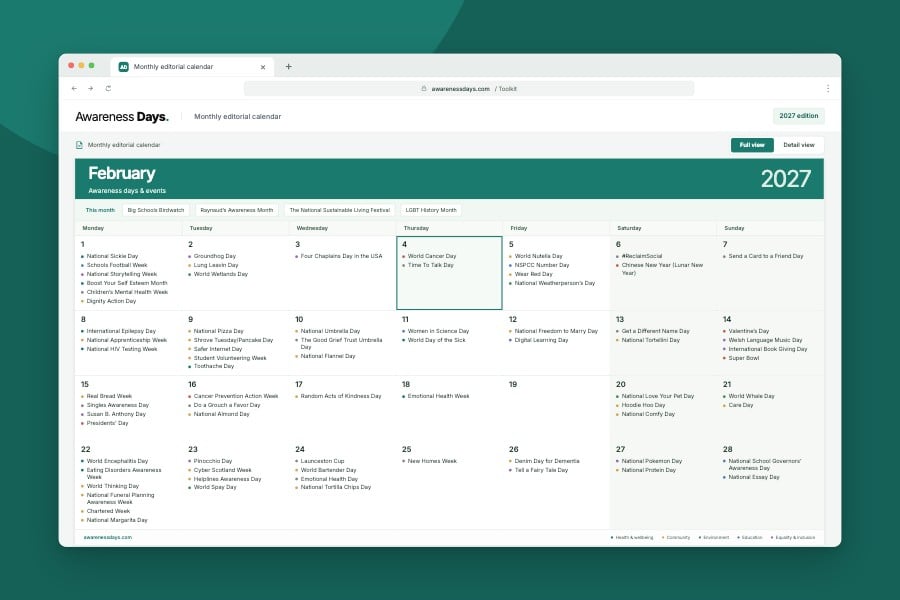
Build your 2027 editorial calendar
The dates are already added. Filter the Google Sheet, work in Excel, or use the printable calendars.
Is St Andrew’s Day a bank holiday?
Yes, in Scotland. The Scottish Government’s list of Scottish bank holidays on mygov.scot includes St Andrew’s Day on 30 November 2026. It became a bank holiday through the St Andrew’s Day Bank Holiday (Scotland) Act 2007, a member’s bill introduced by Dennis Canavan MSP, passed by the Scottish Parliament on 29 November 2006 and in force from January 2007.
There is an important caveat. The explanatory notes to the Act say that bank holiday law “does not require banks (or any other employer) to close on bank holidays”, and mygov.scot adds that bank holidays do not have to be given as paid leave. In practice many Scottish employers and councils treat St Andrew’s Day as a normal working day, or swap it for a local holiday. Schools follow their council’s term dates, so some are open and some are closed. Check your contract or your council’s holiday list rather than assuming.
St Andrew’s Day is not a bank holiday anywhere else in the UK. Banks, shops and offices in England, Wales and Northern Ireland open as usual.
Who was St Andrew, and why is he Scotland’s patron saint?
Andrew was a fisherman from Galilee, the brother of Simon Peter and, in John’s Gospel, the first disciple called by Jesus. Tradition says he preached around the Black Sea and in Greece and was crucified at Patras on an X-shaped cross, the shape now known as a saltire. He never came to Scotland. His connection with the country rests on two stories: that a monk called St Rule (or Regulus) carried some of Andrew’s bones to the east coast of Fife, where the town and cathedral of St Andrews grew up around them; and that in 832 the Pictish king Angus, facing a larger Northumbrian army near what is now Athelstaneford in East Lothian, saw a white saltire of cloud against the blue sky, vowed to make Andrew patron of his people if he won, and did.
Andrew’s status was fixed in 1320, when the Declaration of Arbroath, Scotland’s appeal to the Pope for recognition as an independent kingdom, named him as the nation’s patron. The original relics at St Andrews were lost at the Reformation; relics given by Pope Paul VI in 1969 are kept at St Mary’s Cathedral in Edinburgh.
The saltire
The white diagonal cross on a blue field is the flag of Scotland and one of the oldest national flags still in use. The Scottish Flag Trust tells the Athelstaneford story at its Flag Heritage Centre behind the village church. On St Andrew’s Day the flag is flown from public buildings across Scotland, and many councils, schools and businesses do the same. Blue and white bunting, face paint and the flag itself are the easiest way to mark the day at home or at work.
What happens in Scotland on St Andrew’s Day
St Andrew’s Day has no single fixed ritual in the way Burns Night has its supper. It is a loose, local celebration, and most of it happens on the nearest weekend rather than on 30 November itself.
- St Andrews, Fife. The town named after the saint holds the largest single event, the Big Hoolie, organised by BID St Andrews with VisitScotland and Fife Council. The 2026 Big Hoolie is confirmed for Saturday 28 November 2026. In recent years it has run from a daytime market on South Street to live music, a mass outdoor ceilidh and a torchlit procession down to the West Sands for fireworks.
- Edinburgh. The capital’s celebrations are mainly ceilidhs, concerts and family events on the weekend nearest the date, with the saint’s relics at St Mary’s Cathedral a focus for the religious side of the day.
- Dundee, Glasgow and elsewhere. VisitScotland lists the Dundee Hoolie alongside the St Andrews event, and Glasgow’s pubs and halls fill with St Andrew’s Day ceilidhs over the same weekend.
- Community events. The Scottish Government funds a programme of St Andrew’s Day events in the final week of November through its Winter Festivals budget, which in past years has covered around 100 events including St Andrew’s Fair Saturday, a nationwide day of fundraising concerts and performances, and multicultural events run by BEMIS Scotland. The 2026 programme had not been published when this page was last reviewed.
- Scots abroad. St Andrew’s societies in Canada, the United States, Australia and across Europe hold dinners and dances on or around the date.
What to eat and drink
There is no one St Andrew’s Day dish, so most people reach for the Scottish classics. Haggis with neeps and tatties is the usual centrepiece, with Cullen skink (smoked haddock soup), Scotch broth or stovies as alternatives. For pudding, cranachan (cream, raspberries, toasted oats, honey and whisky), clootie dumpling with custard, or shortbread. A dram of whisky, or Irn-Bru for the drivers, finishes most tables. Restaurants across Scotland run St Andrew’s Day menus during the week, so book ahead for the Saturday.
Frequently asked questions
When is St Andrew’s Day 2026?
St Andrew’s Day 2026 is on Monday 30 November 2026. The date is fixed every year; 2027 falls on a Tuesday.
Is St Andrew’s Day a bank holiday in Scotland?
Yes. It has been a Scottish bank holiday since 2007, but employers do not have to close or give paid leave, so many people work as normal. When 30 November is a weekend the holiday moves to the Monday, as it did in 2025.
Is St Andrew’s Day a bank holiday in England?
No. It is not a bank holiday in England, Wales or Northern Ireland, and businesses there open as usual.
Why is St Andrew the patron saint of Scotland?
Legend says his relics were brought to Fife and that King Angus saw his cross in the sky before winning a battle in 832. He was formally named Scotland’s patron in the Declaration of Arbroath in 1320.
What do people do on St Andrew’s Day?
Ceilidhs, torchlit processions, Scottish food such as haggis, neeps and tatties, and flying the saltire. The biggest public event is the Big Hoolie in St Andrews on the nearest Saturday.
Is St Andrew’s Day the same as Burns Night?
No. St Andrew’s Day on 30 November honours Scotland’s patron saint; Burns Night on 25 January celebrates the poet Robert Burns with a supper and his poems.
More awareness days in November
See all → 30 Nov30 NovMondayBusiness & FinanceInternationalCyber Monday 2026
 1–30 NovMonth1 Nov to 30 NovMonthHealth & WellbeingUK, US, Australia and worldwideMovember 2026 – Men’s Health Awareness Month
 5 Nov5 NovThursdaySeasonalUKBonfire Night (Guy Fawkes Night)
 8 Nov8 NovSundayReligious & FaithInternationalDiwali