
VE (Victory in Europe) Day 2027
Saturday 8 May 2027
VE Day, short for Victory in Europe Day, marks the formal acceptance by the Allies of Nazi Germany’s unconditional surrender on 8 May 1945. It brought almost six years of war in Europe to a close.
Add this date to my calendarA full year of awareness dates, ready to edit, print or sync.
Get the full 2027 awareness days calendar£39 a year. Renews annually.
On this page
Dates and event details
VE (Victory in Europe) Day 2027 is on Saturday 8 May 2027. VE Day is always held on 8 May, the anniversary of the day in 1945 when the Second World War ended in Europe, so the date never moves.
| Year | Date | Day |
|---|---|---|
| 2026 | 8 May 2026 | Friday |
| 2027 | 8 May 2027 | Saturday |
| 2028 | 8 May 2028 | Monday |
| Where | UK |
|---|
What VE Day is
VE Day, short for Victory in Europe Day, marks the formal acceptance by the Allies of Nazi Germany’s unconditional surrender on 8 May 1945. It brought almost six years of war in Europe to a close. It is not a single-organisation campaign: the national programme is led by the UK Government through the Department for Culture, Media and Sport, and the Royal British Legion leads remembrance for the Armed Forces community, with the Imperial War Museums holding the national collection of VE Day stories, photographs and film.
In the UK, VE Day is a day of both celebration and remembrance. Street parties, bunting and 1940s music recall the spontaneous joy of 1945, while services, wreath-laying and a two-minute silence honour the servicemen and women who did not come home and the civilians who lived through the war. Landmark anniversaries (the 50th in 1995, the 75th in 2020 and the 80th in 2025) are marked with national events; in other years it is mostly local councils, Legion branches, schools and churches that organise commemorations.
How to take part
At home. Observe a two-minute silence at 12 noon, hang bunting or a flag, bake something from a wartime recipe book, or watch one of the IWM’s VE Day films. If you have relatives who lived through the war, record their memories; the Royal British Legion collects VE Day stories from the public on its website.
In your street or community. Councils generally allow residents to close a street for a party; apply several weeks ahead, as most require four to twelve weeks’ notice. The Royal British Legion publishes guidance for community events, and many branches welcome volunteers to help with services and parades.
In schools. VE Day fits naturally into Second World War topics in Key Stage 2 and GCSE history. Ideas that work well include a 1940s dress-up day, a mock street party, letters or cards for veterans in local care homes, a two-minute silence in assembly, and using IWM’s free learning resources and photographs.
In workplaces. Mark the silence at 12 noon, invite a Legion speaker, run a tea-party fundraiser for the Poppy Appeal or another Armed Forces charity, and share the day on internal channels with the history above.
What happened on 8 May 1945
Germany’s surrender was signed twice. On 7 May 1945 at Reims in France, General Alfred Jodl signed the instrument of surrender in front of General Eisenhower, the Supreme Allied Commander. A second signing took place in Berlin on 8 May at the insistence of the Soviet Union, with Field Marshal Wilhelm Keitel signing for Germany. The news was broadcast on the evening of 7 May and the following day was declared a national holiday.
At 3pm on 8 May, Winston Churchill broadcast to the nation that the war in Europe was over, warning that “a brief period of rejoicing” should not distract from the fighting still to come in the Far East. Crowds filled Trafalgar Square, Piccadilly Circus and The Mall. King George VI, Queen Elizabeth and Princesses Elizabeth and Margaret appeared on the Buckingham Palace balcony eight times, with Churchill joining them. Later that evening the two princesses slipped out to mingle anonymously with the crowds, a night the future Queen later described as one of the most memorable of her life.
VE Day was not the end of the Second World War. Fighting against Japan continued until its surrender on 14 August 1945, marked as VJ Day, with the formal signing on 2 September 1945.
VE Day 80 in 2025: how the anniversary was marked
The 80th anniversary in May 2025 was the largest national commemoration since VE Day 75 and set the pattern that many communities now follow. The UK Government ran a four-day programme from Monday 5 to Thursday 8 May 2025:
- Monday 5 May: a military procession of more than 1,300 members of the Armed Forces, uniformed services and young people marched from Parliament Square along Whitehall and The Mall to Buckingham Palace, watched by the King and Queen, the Prime Minister and Second World War veterans. A flypast including the Red Arrows followed at 1.45pm. Street parties were held across the country over the bank holiday.
- Tuesday 6 May: nearly 30,000 ceramic poppies from the 2014 Tower of London installation returned to the Tower for the anniversary.
- Thursday 8 May: a national two-minute silence at 12 noon, held during a Service of Thanksgiving at Westminster Abbey attended by the King and Queen and more than 70 veterans. The Royal British Legion hosted a tea party for Second World War veterans at the National Memorial Arboretum in Staffordshire, and the programme closed with a concert for more than 10,000 people on Horse Guards Parade. Public buildings around the UK were lit up in tribute from 6 to 8 May.
A matching national silence at 12 noon on 15 August 2025 marked VJ Day 80. Full details of the 2025 programme are on the gov.uk VE Day 80 pages.
How VE Day is marked in the UK each year
Outside the big anniversaries, VE Day in Britain is a community occasion rather than a day off work. Typical events include:
- Services and wreath-laying at war memorials, often organised by the local Royal British Legion branch, the parish council or a church, usually with a two-minute silence.
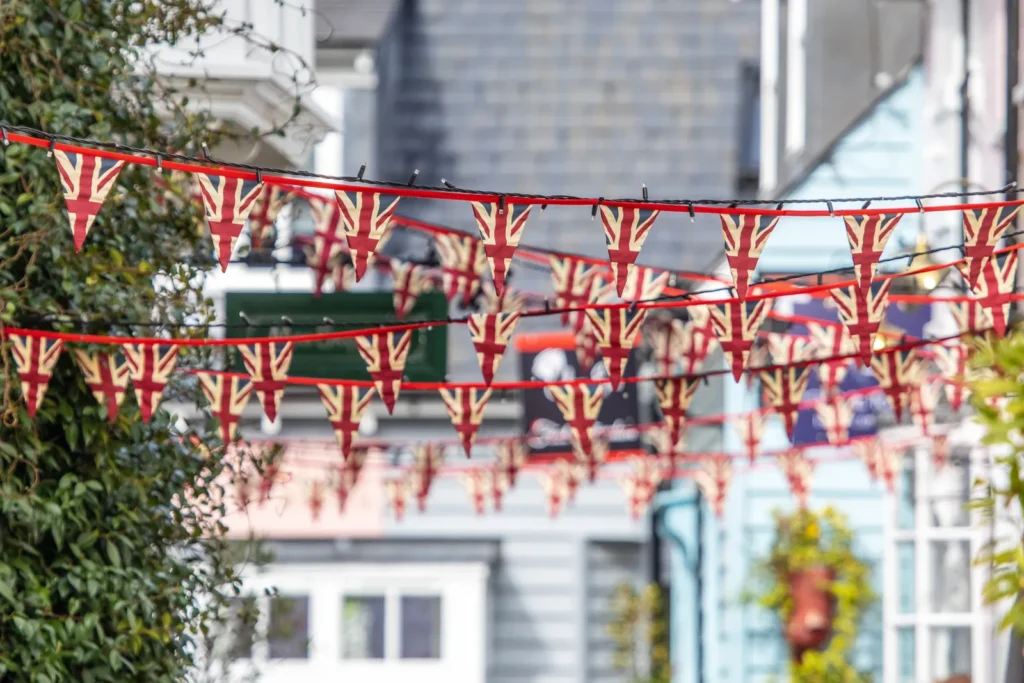
- Street parties and tea parties with red, white and blue bunting, 1940s music and wartime recipes, following the tradition of 1945.
- Flag-raising on council buildings and town halls on 8 May.
- School assemblies and projects on the home front, evacuation, rationing and the end of the war.
- Museum events, including at IWM London, IWM Duxford and IWM North, the National Memorial Arboretum and local museums.
Because 8 May 2027 falls on a Saturday, expect many community events to take place on the day itself, with some councils holding services on the Friday so that schools can take part.
Is VE Day a bank holiday?
No. VE Day is not a bank holiday in the UK in a normal year, and 8 May 2027 is not one. The Early May bank holiday normally falls on the first Monday of May, which in 2027 is Monday 3 May. The early May bank holiday has been moved to 8 May only twice: in 1995 for the 50th anniversary and in 2020 for the 75th, when it shifted from Monday 4 May to Friday 8 May, as confirmed in the gov.uk announcement. No change was made for the 80th anniversary in 2025, and none has been announced for 2027.
Frequently asked questions
When is VE Day 2027?
VE Day 2027 is on Saturday 8 May 2027. It is held on 8 May every year, so VE Day 2026 was Friday 8 May 2026 and VE Day 2028 will be Monday 8 May 2028.
What does VE Day stand for?
VE stands for Victory in Europe. The day marks the Allies’ acceptance of Germany’s unconditional surrender on 8 May 1945, which ended the Second World War in Europe.
Is there a two-minute silence on VE Day?
There is no fixed annual silence, but on major anniversaries the Government has asked for one at 12 noon on 8 May, as it did in 2025. Many local services and Royal British Legion events keep a two-minute silence each year.
Is VE Day a bank holiday in the UK?
No. The early May bank holiday was moved to 8 May only in 1995 and 2020. In 2027 the early May bank holiday is Monday 3 May, and VE Day on Saturday 8 May is a normal day.
What is the difference between VE Day and VJ Day?
VE Day (8 May) marks the end of the war in Europe in 1945. VJ Day (15 August) marks the surrender of Japan and the end of the Second World War as a whole.
How is VE Day celebrated in the UK?
With services and wreath-laying at war memorials, street and tea parties with bunting and 1940s music, flag-raising at town halls, school projects and museum events. National processions, flypasts and concerts are held on milestone anniversaries such as the 80th in 2025.
More awareness days in May
See all → 9 May9 MaySundayCommunityInternationalMother’s Day 2027 US
 10–16 MayWeek10 May to 16 MayWeekHealth & WellbeingUKMental Health Awareness Week 2027
 12 May12 MayWednesdayCommunityInternationalInternational Nurses Day 2027
 15 May15 MaySaturdayArts & Culture AwarenessInternationalEurovision Song Contest 2027