World Kiswahili Language Day 2027
Wednesday 7 July 2027
Dates can vary from year to year, so check the organiser’s website for the latest details.
World Kiswahili Language Day on 7 July celebrates Kiswahili as a language of communication, culture, learning and dialogue.
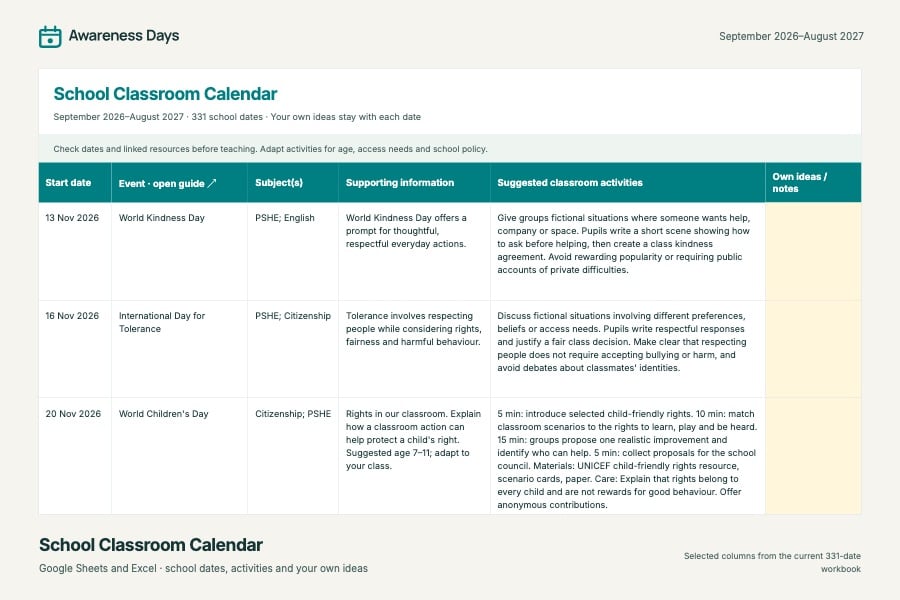
Add this date to my calendarA full year of awareness dates, ready to edit, print or sync.
Get the full 2027 school calendar£49.99 a year. Renews annually.
On this page
Dates and event details
Wednesday 7 July 2027. Held every year on 7 July.
| Date status | Date calculated from a fixed annual pattern |
|---|---|
| Date-check source | United Nations / relevant UN agency |
| Where | International |
About World Kiswahili Language Day
World Kiswahili Language Day takes place on 7 July 2027. This international observance celebrates Kiswahili as a language of communication, culture, learning and dialogue. It gives schools, workplaces and community organisations a focused opportunity to learn, ask questions and plan an activity suited to their audience.
When is World Kiswahili Language Day?
The annual date is 7 July. The 2027 occurrence follows the established annual calendar date; no unannounced 2027 theme or programme is assumed here. See the official source for the observance and current information.
Ideas for schools, libraries and workplaces
The following are editorial activity suggestions to adapt to your setting, rather than an official event programme.
- Start with a reliable resource. Invite a competent teacher or speaker to introduce suitable beginner material. Explain where it comes from and let participants practise without turning pronunciation into a competition.
- Explore a cultural work. Choose a lawfully available poem, story, song discussion or other work. Identify its creator and context, and check permissions before reproducing or performing material.
- Build a multilingual display. Include Kiswahili alongside other languages used in the community. Label resources clearly so readers can find suitable materials at their level.
- Discuss language and access. Ask how a library, school or workplace decides which languages to provide. Identify a practical question that the responsible team can review.
Making the activity useful
A class can examine how a translation changes depending on audience and purpose. Learners might compare two short, authorised versions of a text and record the questions they would ask a translator. This keeps the activity connected to careful reading rather than an unsupported claim that one version is universally correct.
When inviting a community contributor, agree their topic, access needs, payment and permission for any recording. People may enjoy sharing their language without wanting to explain their identity or migration history. Provide choices about participation and avoid assuming that somebody can teach or interpret simply because they speak a language.
Official information
The date and factual background were checked against official UN-system information on 23 October 2026. Practical suggestions are original editorial planning ideas. Check new official announcements before using edition-specific themes, speaker details or registration information.
Background and purpose
UNESCO proclaimed 7 July as World Kiswahili Language Day at its 2021 General Conference through resolution 41 C/61. The United Nations General Assembly subsequently recognised the day through resolution A/RES/78/312. The annual date supports the 2027 observance; a 2027 theme or event programme has not been verified for this guide.
Kiswahili, also known as Swahili, is used across several countries and communities. UNESCO’s campaign highlights its role in multilingualism, cultural identity and dialogue. A useful local activity can introduce a language resource, a piece of literature or a specific speaker’s experience without suggesting that one country, accent or story represents every Kiswahili-speaking community.
Frequently asked questions
When is World Kiswahili Language Day 2027?
What is World Kiswahili Language Day 2027?
More awareness days in July
See all → 7 Jul7 JulWednesdayFood & NutritionUK, US, Australia and worldwideWorld Chocolate Day 2027
 17 Jul17 JulSaturdayFun & QuirkyInternationalWorld Emoji Day 2027
 24 Jul24 JulSaturdayHealth & WellbeingUK, US, Australia and worldwideInternational Self-Care Day 2027
 28 Jul28 JulWednesdayEnvironmentInternationalWorld Nature Conservation Day