

International Day for Universal Access to Information 2026
Monday 28 September 2026
The International Day for Universal Access to Information, often shortened to IDUAI, is a global observance dedicated to the principle that access to information is a fundamental right.
Add this date to my calendarA full year of awareness dates, ready to edit, print or sync.
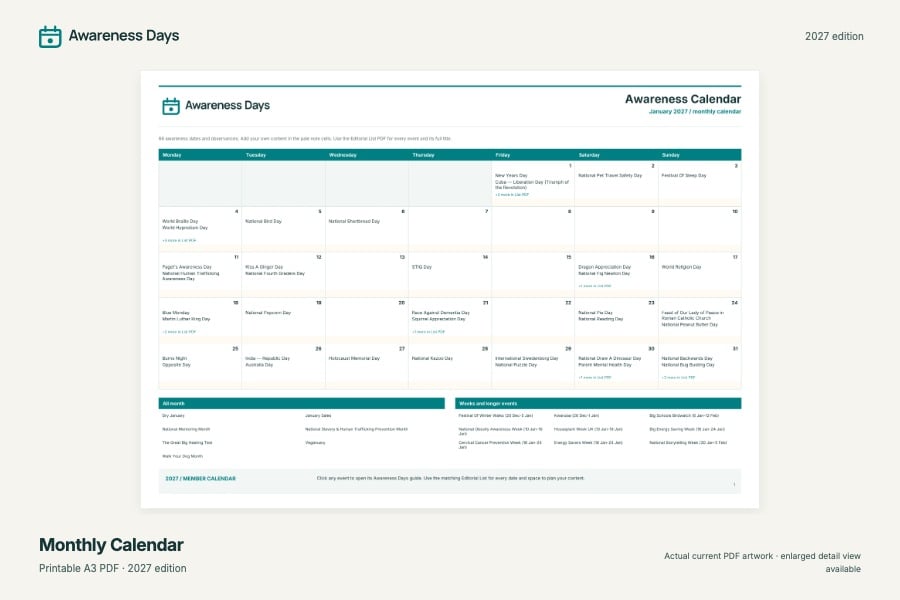
Get the full 2027 awareness days calendar£49.99 a year. Renews annually.
On this page
Dates and event details
Monday 28 September 2026
| Where | International |
|---|
What is the International Day for Universal Access to Information?
The International Day for Universal Access to Information, often shortened to IDUAI, is a global observance dedicated to the principle that access to information is a fundamental right. It is coordinated by UNESCO, the United Nations Educational, Scientific and Cultural Organization, and supported by governments, civil society groups, journalists and information commissioners around the world. The day focuses on the importance of strong access to information laws, their effective implementation, and the role that open public records play in healthy democracies. Each year carries a specific theme that connects the right to information to wider issues such as the environment, public participation and the digital age.
The International Day for Universal Access to Information takes place every year on 28 September. Led by UNESCO and recognised by the United Nations, the day promotes the right of every person to seek, receive and share information held by public bodies, and highlights the laws and practices that make government transparency possible. In 2026 it falls on Monday, 28 September.
When is the International Day for Universal Access to Information?
The International Day for Universal Access to Information is held on 28 September every year. The date is fixed and does not move, so it always lands on the same calendar day regardless of the year. In 2026 the observance falls on Monday, 28 September. The date was chosen to align with the long-running International Right to Know Day, which civil society groups had marked on 28 September since 2002.
How to Get Involved in the International Day for Universal Access to Information
There are many ways to mark the day, whether you are an individual, a journalist, a public servant or part of a campaigning organisation.
- Submit a request for information – Use your country’s freedom of information or right to information law to ask a public body a genuine question. Exercising the right is one of the most direct ways to test how well it works.
- Learn your legal rights – Read up on the access to information legislation that applies where you live, including the deadlines public bodies must meet and the routes available if a request is refused.
- Share open data – If you work for a public body, publish datasets, registers and reports proactively so that people do not have to ask for them in the first place.
- Support information commissioners – Many countries have independent oversight bodies that enforce access rights. Following and supporting their work helps keep the system accountable.
- Host or join an event – Universities, libraries and civil society groups often run talks, training sessions and panel discussions on the day. Attending or organising one spreads practical knowledge.
- Champion press freedom – Journalists rely heavily on access to information to investigate stories in the public interest. Supporting independent media protects this part of the information ecosystem.
- Educate young people – Talk to students about why open government matters and how to find reliable public information, building media and information literacy from an early age.
- Raise awareness online – Share UNESCO’s resources and the year’s theme with your own networks to help more people understand a right that many do not know they have.
Why the International Day for Universal Access to Information Matters
Access to information underpins almost every other right. When citizens can find out how decisions are made, how public money is spent and how services are run, they are better placed to hold those in power to account. Open information also supports anti-corruption efforts, strengthens public trust and helps communities respond to crises with accurate, timely facts.
The scale of progress is significant but uneven. According to United Nations and UNESCO tracking, around 139 countries have adopted constitutional, statutory or policy guarantees for public access to information, covering roughly 90 per cent of the world’s population. Yet adoption is only the first step. UNESCO’s most recent monitoring under Sustainable Development Goal indicator 16.10.2 gathered data from more than 120 countries and territories and found that many access to information laws are weakened by limited budgets, slow response times, broad exemptions and weak enforcement. The day exists to keep this gap between law and practice in the public eye.
Noteworthy Facts About the International Day for Universal Access to Information
- UNESCO proclaimed the day in November 2015, and the first official observance was held on 28 September 2016.
- The United Nations General Assembly adopted the day at its 74th session on 15 October 2019.
- The 28 September date was inherited from International Right to Know Day, marked by civil society since 2002.
- Around 139 countries have adopted guarantees for public access to information, covering about 90 per cent of the global population.
- The day is directly linked to Sustainable Development Goal indicator 16.10.2, which monitors public access to information worldwide.
Links
- Visit the official UNESCO International Day for Universal Access to Information page
- Explore more awareness days at AwarenessDays.com
Featured image: Photo by Pauline Andan on Unsplash.
History of the International Day for Universal Access to Information
The roots of the day reach back to 2002, when civil society advocates began marking 28 September as International Right to Know Day. The aim was to draw attention to the right of ordinary people to access information held by their governments. Over the following years the campaign gathered momentum, particularly among African civil society groups who pressed for stronger transparency laws across the continent.
In November 2015, UNESCO’s General Conference formally proclaimed 28 September as the International Day for Universal Access to Information. The first official observance under the UNESCO banner took place on 28 September 2016. This gave the cause a permanent place in the international calendar and a coordinating body with global reach.
The day was elevated further on 15 October 2019, when the United Nations General Assembly, at its 74th session, proclaimed 28 September as the International Day for Universal Access to Information at the level of the whole United Nations. This recognition reflected a growing consensus that access to information is essential to achieving the Sustainable Development Goals, in particular Goal 16, which calls for peaceful, just and inclusive societies. Since then the day has continued to grow, with annual themes addressing issues from artificial intelligence and digital transformation to environmental transparency and public participation.
Hashtags
Help raise awareness by sharing the International Day for Universal Access to Information with your friends, family, and followers. Use the hashtags #AccessToInfoDay and #AccessToInfoDay2026 on social media. The more people who understand their right to information, the stronger the demand for open and accountable government becomes.
Frequently asked questions
What is the International Day for Universal Access to Information?
It is a global UNESCO and United Nations observance held each year on 28 September that promotes the right of everyone to access information held by public bodies, and highlights the laws and practices that make government transparency possible.
When is the International Day for Universal Access to Information in 2026?
The day takes place on Monday, 28 September 2026. The date is fixed and is the same every year.
Who organises the International Day for Universal Access to Information?
UNESCO coordinates the day at the international level, working with member states, civil society organisations, information commissioners and the wider United Nations system. The United Nations General Assembly formally recognised the observance in 2019.
More awareness days in September
See all → 16–22 SepWeek16 Sep to 22 SepWeekScience & TechnologyInternationalNational Coding Week 2026
 21 Sep – 4 OctWeek21 Sep to 4 OctWeekEducation & YouthUK, US, Australia and worldwideFairtrade Fortnight 2026
 28 Sep28 SepMondayAnimals & WildlifeUK, US, Australia and worldwideWorld Rabies Day
 28 Sep28 SepMondayCommunityUSNational Good Neighbor Day