

International Day of Combating Sand and Dust Storms 2026
Sunday 12 July 2026
The International Day of Combating Sand and Dust Storms is a United Nations observance dedicated to highlighting one of the most underrecognised environmental hazards of our time.
A full year of awareness dates, ready to edit, print or sync.
Get the full 2027 awareness days calendar£49.99 a year. Renews annually.
On this page
Dates and event details
Sunday 12 July 2026
| Where | International |
|---|
What is the International Day of Combating Sand and Dust Storms?
The International Day of Combating Sand and Dust Storms is a United Nations observance dedicated to highlighting one of the most underrecognised environmental hazards of our time. Sand and dust storms are weather events in which strong winds lift large quantities of fine particles from dry, degraded, or poorly managed land and carry them across regions, countries, and even continents. The day is championed by the United Nations Convention to Combat Desertification (UNCCD), with support from the Food and Agriculture Organization (FAO) and a wider coalition of UN agencies. It calls on governments, scientists, and citizens to treat sand and dust storms as a shared challenge that crosses borders and requires international cooperation.
The International Day of Combating Sand and Dust Storms takes place on 12 July each year. Established by the United Nations General Assembly, the day raises awareness of the health, environmental, and economic damage caused by sand and dust storms, and promotes coordinated action to reduce their impact on communities around the world.
When is the International Day of Combating Sand and Dust Storms?
The International Day of Combating Sand and Dust Storms falls on Sunday, 12 July 2026. The date is fixed, so the observance is held on 12 July every year regardless of the day of the week. It was designated by the UN General Assembly to provide an annual focal point for awareness raising, scientific exchange, and policy action.
How to Get Involved in the International Day of Combating Sand and Dust Storms
There are many ways individuals, schools, businesses, and governments can mark the day and contribute to long-term solutions:
- Learn the science – Read briefings from the UNCCD, FAO, and World Health Organization to understand how sand and dust storms form, where they originate, and how they affect health and livelihoods.
- Share verified information – Use the day to post facts and resources on social media, correcting the common assumption that these storms are purely natural and unavoidable.
- Support sustainable land management – Back projects that restore degraded land, plant vegetation barriers, and protect soil, since healthy land is the most effective defence against dust emissions.
- Check local air quality – Encourage your community to monitor air quality forecasts and follow guidance during dust events, especially for children, older people, and those with respiratory conditions.
- Engage schools and universities – Organise lessons, talks, or research projects that connect sand and dust storms to climate change, desertification, and the Sustainable Development Goals.
- Lobby for early warning systems – Call on decision makers to invest in forecasting and early warning tools that give communities time to prepare for incoming storms.
- Reduce your environmental footprint – Support water conservation and responsible agriculture, both of which help prevent the land degradation that feeds dust storms.
- Join coalition activities – Follow the United Nations Coalition on Combating Sand and Dust Storms and take part in events, webinars, and campaigns held around 12 July.
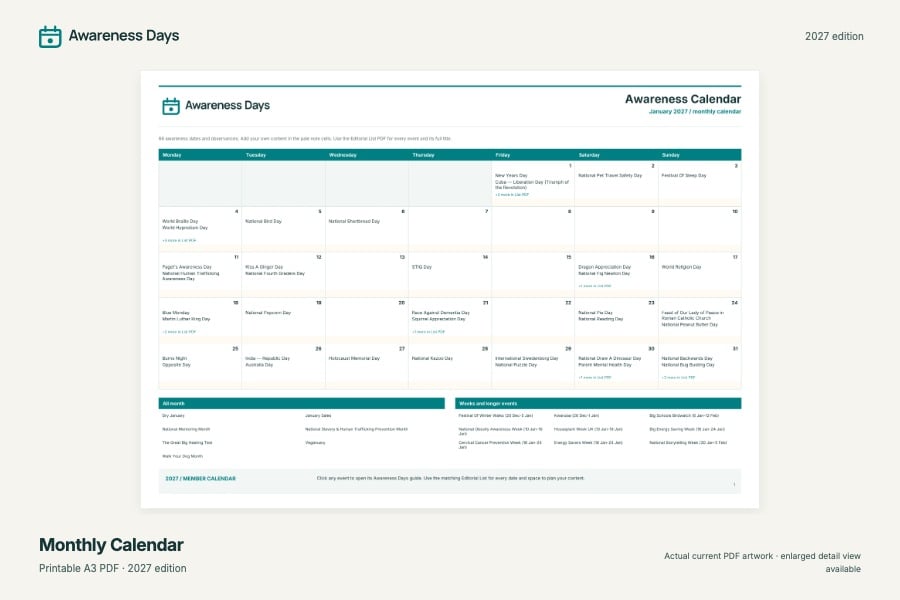
Build your 2027 editorial calendar
The dates are already added. Filter the Google Sheet, work in Excel, or use the printable calendars.
Why the International Day of Combating Sand and Dust Storms Matters
Sand and dust storms are far more than a regional nuisance. According to the UNCCD, an estimated 2 billion tonnes of sand and dust enter the atmosphere every year, a mass roughly equal in weight to 350 Great Pyramids of Giza. These storms threaten the realisation of 11 of the 17 Sustainable Development Goals, undermining progress on health, food security, clean air, and economic growth all at once.
The human cost is significant. Airborne particulate matter, including the fine dust carried by these storms, contributes to millions of premature deaths worldwide each year and worsens conditions such as asthma, bronchitis, and other respiratory and cardiovascular illnesses. Dust can also transport pathogens linked to diseases including meningitis and valley fever. Beyond health, sand and dust storms damage farmland, reduce crop yields by as much as 25 per cent in some regions, disrupt transport and energy infrastructure, and ground flights. In the Middle East and North Africa alone, the cost of dealing with sand and dust storms has been estimated at around 150 billion US dollars a year, equivalent to roughly 2.5 per cent of regional GDP. Crucially, at least a quarter of global dust emissions originate from human activity such as unsustainable land and water use, which means much of the problem is preventable. This connects the day directly to wider efforts marked by the World Day to Combat Desertification and Drought.
Noteworthy Facts About the International Day of Combating Sand and Dust Storms
- The UN General Assembly proclaimed the day on 8 June 2023 through resolution A/RES/77/294, with the first observance held on 12 July of that year.
- Around 2 billion tonnes of sand and dust enter the atmosphere annually, equivalent in weight to roughly 350 Great Pyramids of Giza.
- Some 151 UNCCD country Parties, around 77 per cent, are directly affected by sand and dust storms, while 45 Parties are classified as source areas.
- At least 25 per cent of global dust emissions are linked to human activities such as unsustainable land and water management.
- The United Nations declared 2025 to 2034 the Decade on Combating Sand and Dust Storms, reinforcing the importance of the annual day.
Links
History of the International Day of Combating Sand and Dust Storms
Concern about sand and dust storms has been building within the United Nations for many years. A series of General Assembly resolutions adopted between 2015 and 2021 repeatedly warned that these storms posed a growing threat to sustainable development, particularly in arid and semi-arid regions of Africa, Asia, and the Middle East. In 2019, UNCCD Parties formally launched the United Nations Coalition on Combating Sand and Dust Storms at the fourteenth Conference of the Parties, committing the UN system to a coordinated, proactive response.
The observance itself was created on 8 June 2023, when the UN General Assembly adopted resolution A/RES/77/294 proclaiming 12 July as the International Day of Combating Sand and Dust Storms. The resolution invited all member states and stakeholders to mark the day through education and public awareness activities focused on protecting human health, promoting sustainable land management, strengthening food security, and building resilience to climate change.
Momentum has continued to grow since then. On 10 July 2024, the General Assembly adopted resolution A/RES/78/314, declaring 2025 to 2034 the United Nations Decade on Combating Sand and Dust Storms. This dedicated decade gives the annual day a long-term framework, ensuring that awareness raised each 12 July feeds into sustained global policy and investment over the years ahead.
Hashtags
Help raise awareness by sharing the International Day of Combating Sand and Dust Storms with your friends, family, and followers. Use the hashtags #SandAndDustStorms and #CombatingSDS2026 on social media. The more people who understand that sand and dust storms are a preventable, global challenge, the greater the pressure for lasting action.
Frequently asked questions
What is the International Day of Combating Sand and Dust Storms?
It is a United Nations observance held on 12 July each year to raise awareness of the health, environmental, and economic harm caused by sand and dust storms, and to promote coordinated action to reduce their impact.
When is the International Day of Combating Sand and Dust Storms in 2026?
It takes place on Sunday, 12 July 2026, and on 12 July every year, as the date is fixed.
Who organises the International Day of Combating Sand and Dust Storms?
The day is led by the United Nations Convention to Combat Desertification (UNCCD), working with the Food and Agriculture Organization and the wider United Nations Coalition on Combating Sand and Dust Storms.