

National Hair Loss Awareness Month 2027
All of August 2027
National Hair Loss Awareness Month is an annual health observance held every August to raise public understanding of hair loss in all its forms, from common male and female pattern baldness to autoimmune conditions such as alopecia areata.
A full year of awareness dates, ready to edit, print or sync.
Get the full 2027 health calendar£49.99 a year. Renews annually.
On this page
Dates and event details
National Hair Loss Awareness Month 2026 ran from Saturday 1 August to Monday 31 August 2026. The next National Hair Loss Awareness Month runs from Sunday 1 August to Tuesday 31 August 2027.
| Where | US |
|---|
What is National Hair Loss Awareness Month?
National Hair Loss Awareness Month is an annual health observance held every August to raise public understanding of hair loss in all its forms, from common male and female pattern baldness to autoimmune conditions such as alopecia areata. The month is championed by groups including the American Academy of Dermatology (AAD), the American Hair Loss Association, and the American Hair Loss Council, alongside dermatologists and trichologists across the country. Its core aim is to replace myths and embarrassment with reliable medical guidance, while reminding those affected that they are far from alone.
National Hair Loss Awareness Month takes place throughout August and runs from 1-31 August 2027 in the United States. The observance encourages people to learn about the causes of hair loss, understand the treatment options available, and offer support to the tens of millions of adults and children living with thinning hair, baldness, and alopecia. It is promoted each August by dermatologists and hair loss organisations who use the month to share accurate, evidence-based information.
When is National Hair Loss Awareness Month?
National Hair Loss Awareness Month runs for the whole of August. In 2026 it begins on Sunday 1 August and ends on Tuesday 31 August. The observance is fixed to the month of August every year, so the dates do not change, although the specific themes and campaigns promoted by participating organisations vary from year to year.
How to Get Involved in National Hair Loss Awareness Month
There are many simple ways to mark the month, whether you are personally affected or want to support someone who is.
- See a dermatologist – If you have noticed thinning or shedding, August is a good prompt to book an appointment. A board-certified dermatologist can identify the type of hair loss and recommend treatments that work best when started early.
- Learn the facts – Read trusted resources from the American Academy of Dermatology or the American Hair Loss Association to understand the difference between normal shedding and genuine hair loss.
- Share your story – Talking openly about your own experience on social media or with friends helps normalise hair loss and encourages others to seek help.
- Support a charity – Donate to or fundraise for organisations such as the National Alopecia Areata Foundation, which funds research and supports families affected by alopecia.
- Join a support group – Connecting with others who understand, whether in person or through online forums, offers reassurance and practical advice.
- Donate your hair – Consider donating a ponytail to a charity that makes wigs for people who have lost their hair through medical conditions or treatment.
- Take part in a walk or event – Community events such as the Walk For Alopecia bring people together to raise funds and visibility for hair loss research.
- Check on a friend – A kind message to someone you know who is living with hair loss can make a real difference to how supported they feel.
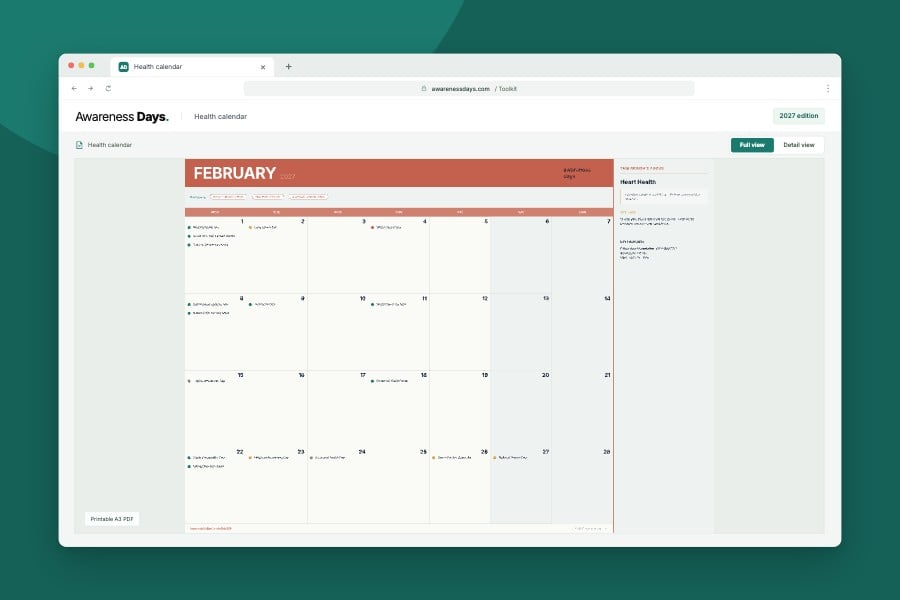
Build your 2027 editorial calendar
The dates are already added. Filter the Google Sheet, work in Excel, or use the printable calendars.
Why National Hair Loss Awareness Month Matters
Hair loss is far more common than many people assume. An estimated 56 million adults in the United States experience hair loss, including roughly 35 million men and 21 million women. Beyond pattern baldness, autoimmune alopecia areata affects close to 6.7 million Americans over their lifetime, with around 700,000 people living with the condition at any given moment, and it can appear in children as well as adults.
The impact of hair loss reaches well beyond appearance. Studies consistently link visible hair loss to lowered self-esteem, anxiety, and social withdrawal, and many people delay seeking help because they wrongly believe nothing can be done. National Hair Loss Awareness Month matters because early diagnosis often widens the range of effective treatments, and because open conversation chips away at the stigma that keeps people suffering in silence. The American Academy of Dermatology reports that its hair loss resources draw nearly 200,000 views from more than 140,000 unique visitors during August alone, a sign of how many people are quietly searching for answers.
Noteworthy Facts About National Hair Loss Awareness Month
- Around 56 million adults in the United States experience hair loss, split roughly between 35 million men and 21 million women.
- Alopecia areata affects close to 6.7 million Americans during their lifetime, with about 700,000 living with it at any one time.
- Hair loss is not exclusive to adults; children can develop alopecia areata too.
- The American Academy of Dermatology, which promotes the month, was founded in 1938.
- During August, AAD hair loss pages attract nearly 200,000 views from over 140,000 unique visitors, showing how widely people seek information.
Links
Featured image: Photo by Towfiqu barbhuiya on Unsplash.
History of National Hair Loss Awareness Month
August has been recognised as National Hair Loss Awareness Month for several years, with the observance gaining momentum as dermatology bodies and hair loss charities adopted it as a focal point for public education. The American Academy of Dermatology, founded in 1938 and now one of the largest dermatology organisations in the world, uses the month each August to publish guidance and position board-certified dermatologists as the trusted source on hair and scalp conditions.
The wider movement to take hair loss seriously as a medical and psychological issue grew through the work of consumer-focused groups. The American Hair Loss Association was established as a nonprofit dedicated to educating the public, and the American Hair Loss Council has long served as an impartial source of information about hair loss and restoration. As awareness around autoimmune alopecia increased, organisations such as the National Alopecia Areata Foundation added their voices, helping to broaden the conversation beyond pattern baldness to include all forms of hair loss.
Over time, the month has shifted from being largely industry-led to a genuinely public health-oriented observance, with a growing emphasis on mental wellbeing, accurate medical information, and reducing the shame that has historically surrounded the subject.
Hashtags
Help raise awareness by sharing National Hair Loss Awareness Month with your friends, family, and followers. Use the hashtags #HairLossAwarenessMonth and #HairLossAwareness2027 on social media. The more people who know about National Hair Loss Awareness Month, the more we can replace stigma with support and accurate information.
Frequently asked questions
What is National Hair Loss Awareness Month?
It is an annual observance held every August in the United States to raise awareness of hair loss, encourage people to seek professional help, and reduce the stigma attached to thinning hair and baldness. It is promoted by dermatologists and hair loss organisations.
When is National Hair Loss Awareness Month in 2027?
It runs for the whole of August, beginning on Sunday 1 August 2027 and ending on Tuesday 31 August 2027.
Who promotes National Hair Loss Awareness Month?
The month is championed by organisations including the American Academy of Dermatology, the American Hair Loss Association, and the American Hair Loss Council, supported by dermatologists and charities such as the National Alopecia Areata Foundation.
More awareness days in August
See all → 8 Aug8 AugSundayAnimals & WildlifeUK, US, Australia and worldwideInternational Cat Day 2027
 19 Aug19 AugThursdayCommunityInternationalWorld Humanitarian Day 2027
 19 Aug19 AugThursdayArts & Culture AwarenessInternationalWorld Photography Day 2027
 23 Aug – 6 SepWeek23 Aug to 6 SepWeekSeasonalInternationalBack to School 2027